
FREE FINANCIAL EDUCATION
Bull put spread
Derive the bounded expiry payoff of a put credit spread.
What you will learn
Prerequisites: Short-put obligation, long-put protection and credit accounting.
- Derive the bounded expiry payoff of a put credit spread.
- Compute maximum loss without confusing credit with risk.
- Calculate position size using net worst-case payoff rather than premium received.
Mechanism and decision rules
A bull put spread sells a put at higher strike K2 and buys a put at lower strike K1, using the same underlying, expiry and units. The initial net credit C is premium received minus premium paid. Expiry profit is C − max(K2 − S, 0) + max(K1 − S, 0). The long lower put bounds the theoretical expiry loss of the intact structure.
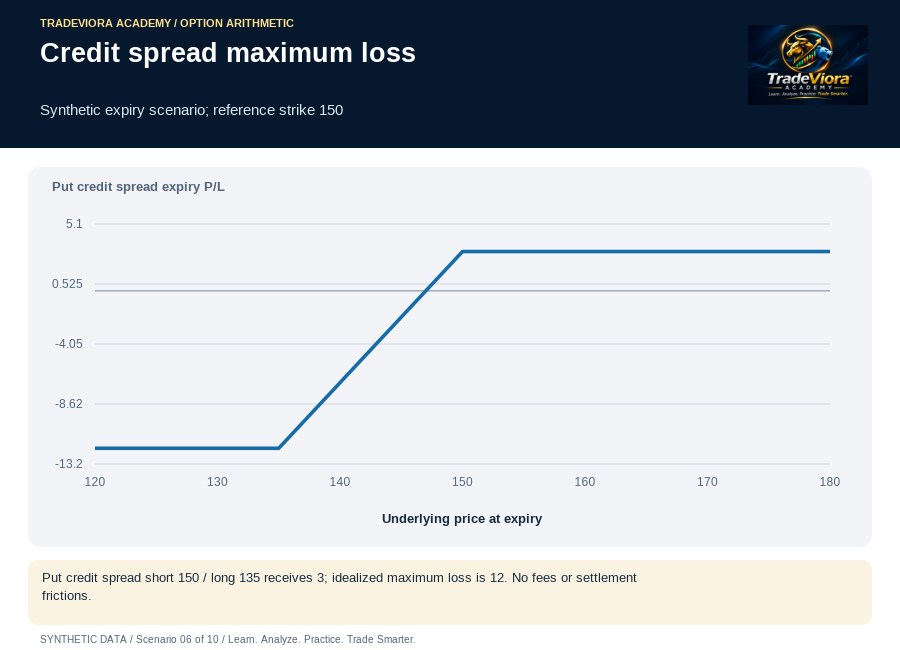
Above K2, both intrinsic payoffs are zero and profit is the credit. Below K1, the intrinsic obligation is the width K2 − K1, so maximum loss is width minus credit. Breakeven is K2 − C. A high frequency of small credits can coexist with occasional losses several times larger; premium collection alone is not an expectancy calculation.
Worked example · synthetic data
Sell a synthetic strike-100 put for ₹6 and buy a strike-90 put for ₹2. Credit is ₹4 and width is ₹10. At expiry S = ₹105, profit is ₹4. At S = ₹97, the short put loses ₹3 intrinsic, so net profit is ₹1. At S = ₹80, the short owes ₹20 and the long pays ₹10, leaving 4 − 20 + 10 = −₹6.
Maximum profit is ₹4, maximum loss ₹6 and breakeven ₹96 per unit. For 50 fictional units, maximum theoretical expiry loss is ₹300 before charges, not the ₹200 premium credit.
Failure modes and limits
The bounded payoff assumes both legs remain effective through the relevant settlement. Early assignment, expiry mismatch, broker liquidation and legging can create separate obligations. Margin required is not necessarily the same as modeled maximum loss. Fees and slippage can materially reduce a small credit.
Practice case
A 250/230 put credit spread receives ₹5 net credit per unit. With fictional units of 40 and a ₹3,000 risk allowance, calculate maximum loss per spread and the maximum whole number of spreads before costs.
Reveal the worked answer
Width is ₹20; maximum loss is ₹15 per unit. One 40-unit spread risks ₹600 in the simplified expiry model. The allowance permits five spreads before additional costs and operational reserves. Sizing by the ₹200 credit per spread would confuse revenue with risk.
Check your understanding
Sources and next steps
The lesson, calculations and synthetic cases are original educational material. References explain underlying contract or chart conventions; none validates the profitability of a trading rule. Actual contract specifications, settlement obligations and charges must be checked before trading.
Explore OHLCV data in the chart lab · Explore volume-at-price and TPO data · Practice library
Related quantitative practice
This separate synthetic case illustrates the arithmetic behind the topic. Its invented inputs are independent of the worked example above.
Download this concept’s cheat sheet · Run the related Python example · Explore scenario illustrations