
FREE FINANCIAL EDUCATION
Protective collar
Combine long stock, long lower-strike put and short higher-strike call.
What you will learn
Prerequisites: Covered calls, protective puts and matching option units.
- Combine long stock, long lower-strike put and short higher-strike call.
- Calculate premium-inclusive floor and cap at expiry.
- Explain the economic cost hidden by a zero-premium collar label.
Mechanism and decision rules
A protective collar holds the underlying, buys a lower-strike put and sells a higher-strike call with matching expiry and quantity. The put sets an expiry floor while the call caps upside. Net option cost is put premium minus call premium; it can be a debit, credit or approximately zero. A zero net premium means the option cash flows offset initially, not that protection has no economic cost.
Let stock entry be S0, put strike Kp, call strike Kc and net option debit D. Expiry profit is S − S0 + max(Kp − S, 0) − max(S − Kc, 0) − D. Below Kp, profit is fixed at Kp − S0 − D. Above Kc, profit is fixed at Kc − S0 − D. Between strikes, the stock’s movement drives the result.
Worked example · synthetic data
Buy synthetic stock at ₹100, buy a 95 put for ₹3 and sell a 110 call for ₹2. Net debit is ₹1. At expiry S = ₹80, stock loses ₹20, the put gains ₹15 intrinsic and the short call has none; after net debit, profit is −₹6. At S = ₹120, stock gains ₹20, the short call loses ₹10 intrinsic and the put has none; profit is ₹9.
Thus maximum expiry loss is ₹6, maximum gain ₹9 and breakeven ₹101 before costs. The collar has exchanged upside above ₹110 for a lower protection cost.
Failure modes and limits
The floor and cap assume intact matched legs and the stated settlement. Early assignment where applicable, dividends and physical delivery can complicate implementation. Closing the put removes the floor; closing the stock can leave an uncovered call. A zero-premium version still sacrifices upside and incurs transaction costs.
Practice case
Stock entry is ₹500. Buy a 470 put for ₹15 and sell a 540 call for ₹15. Find net option debit, maximum expiry loss and maximum expiry gain. Explain why “zero cost” is incomplete.
Reveal the worked answer
Net option debit is zero before fees. Maximum loss is 500 − 470 = ₹30 and maximum gain is 540 − 500 = ₹40 per unit. Upside above ₹540 is surrendered, and spreads, charges and settlement requirements remain; zero initial premium does not mean a free economic benefit.
Check your understanding
Sources and next steps
The lesson, calculations and synthetic cases are original educational material. References explain underlying contract or chart conventions; none validates the profitability of a trading rule. Actual contract specifications, settlement obligations and charges must be checked before trading.
Explore OHLCV data in the chart lab · Explore volume-at-price and TPO data · Practice library
Related quantitative practice
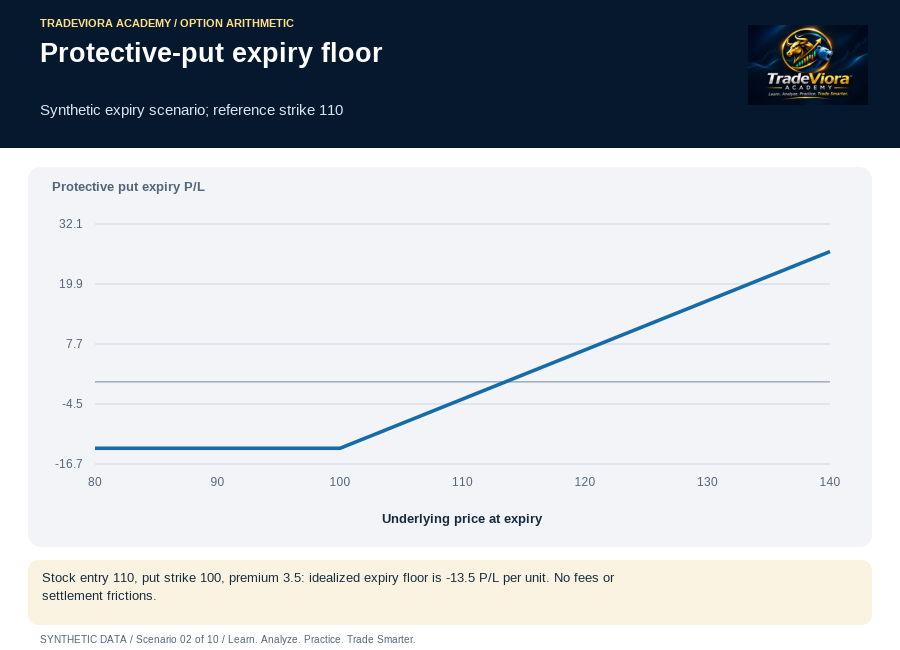
This separate synthetic case illustrates the arithmetic behind the topic. Its invented inputs are independent of the worked example above.
Download this concept’s cheat sheet · Explore scenario illustrations