
FREE FINANCIAL EDUCATION
Bear put spread
Build a bearish debit spread using two same-expiry puts.
What you will learn
Prerequisites: Purchased and written put payoffs; net debit.
- Build a bearish debit spread using two same-expiry puts.
- Calculate profit across the three strike regions.
- Explain the tradeoff between reduced premium and capped downside participation.
Mechanism and decision rules
A bear put spread buys the higher-strike put K2 and sells a lower-strike put K1, with K2 > K1 and matching expiry and units. Net debit D equals premium paid minus premium received. Expiry profit is max(K2 − S, 0) − max(K1 − S, 0) − D. The short lower put reduces the initial cost but gives up additional gains below K1.
Above K2, both options expire without intrinsic value and the spread loses D. Between strikes, value rises as S falls. Below K1, the intrinsic difference is fixed at K2 − K1. Maximum profit is width minus debit, and breakeven is K2 − D before costs. A bearish view alone does not decide whether the debit is economically attractive.
Worked example · synthetic data
Buy a synthetic strike-120 put for ₹12 and sell the strike-100 put for ₹4. Net debit is ₹8 and width is ₹20. At expiry S = ₹110, the higher put pays ₹10 and the lower put zero, leaving profit ₹2. At S = ₹80, they pay ₹40 and ₹20 respectively, leaving spread value ₹20 and profit ₹12.
Maximum loss is ₹8, maximum profit ₹12 and breakeven ₹112 per unit. Once S is below ₹100 at expiry, a further decline adds equal intrinsic value to both puts, leaving the spread unchanged.
Failure modes and limits
The spread’s price before expiry depends on remaining time and volatility, so the expiry diagram is not a complete live valuation. Leg liquidity may differ. Exercise, assignment and delivery obligations are contract-specific. Selling too many lower puts creates a ratio structure with a very different downside risk.
Practice case
Buy a 500 put for ₹30 and sell a 450 put for ₹12. Find debit, width, maximum profit, breakeven and expiry P&L at S = ₹470.
Reveal the worked answer
Debit is ₹18; width is ₹50; maximum profit is ₹32; breakeven is ₹482. At ₹470, the long pays ₹30 and the short zero, so profit is ₹12. Below ₹450, the maximum ₹32 expiry profit remains capped before costs.
Check your understanding
Sources and next steps
The lesson, calculations and synthetic cases are original educational material. References explain underlying contract or chart conventions; none validates the profitability of a trading rule. Actual contract specifications, settlement obligations and charges must be checked before trading.
Explore OHLCV data in the chart lab · Explore volume-at-price and TPO data · Practice library
Related quantitative practice
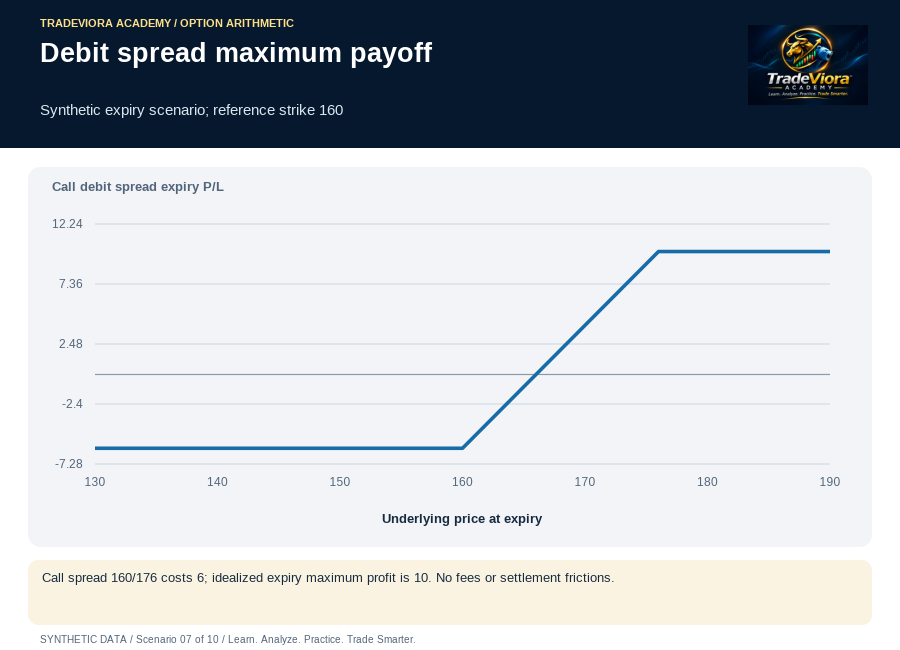
This separate synthetic case illustrates the arithmetic behind the topic. Its invented inputs are independent of the worked example above.
Download this concept’s cheat sheet · Run the related Python example · Explore scenario illustrations