
FREE FINANCIAL EDUCATION
Bull call spread
Derive the payoff of a lower-strike long call and higher-strike short call.
What you will learn
Prerequisites: Long and short call payoff; net premium; same-expiry contracts.
- Derive the payoff of a lower-strike long call and higher-strike short call.
- Compute debit, maximum loss, maximum profit and breakeven.
- Separate expiry payoff limits from leg-by-leg execution risk.
Mechanism and decision rules
A bull call spread buys a call at lower strike K1 and sells a call at higher strike K2 on the same underlying, expiry and units. Net debit D is the premium paid minus premium received. Expiry profit is max(S − K1, 0) − max(S − K2, 0) − D. The short call finances part of the purchase while capping upside above K2.
Below K1, both intrinsic payoffs are zero and the loss is D. Between strikes, profit increases one for one with S. Above K2, intrinsic spread value is the fixed width K2 − K1. Maximum profit is width minus debit, and breakeven is K1 + D before costs. These boundaries assume matching quantities and intact legs.
Worked example · synthetic data
Buy a synthetic strike-100 call for ₹9 and sell the strike-110 call for ₹4. Net debit is ₹5; width is ₹10. At expiry S = ₹107, the long pays ₹7 and the short pays zero, so profit is ₹2. At ₹120, intrinsic values are ₹20 and ₹10, leaving spread value ₹10 and profit ₹5.
Maximum loss is ₹5 and maximum profit is ₹5 per unit; breakeven is ₹105. With 50 fictional units, initial debit and maximum theoretical expiry loss are ₹250 before fees.
Failure modes and limits
Executing legs separately can temporarily leave an uncovered short or an unhedged long. Bid–ask spreads make a midpoint debit optimistic. American assignment and physically settled contracts can create operational obligations before both legs offset as expected. Closing only one leg changes the payoff and must be treated as a new position.
Practice case
Buy a 200 call for ₹16 and sell a 225 call for ₹7. Calculate debit, maximum loss, maximum profit, breakeven and expiry P&L at S = ₹220.
Reveal the worked answer
Debit is ₹9 and width ₹25. Maximum loss is ₹9; maximum profit is 25 − 9 = ₹16; breakeven is ₹209. At ₹220, the long intrinsic is ₹20 and the short zero, producing ₹11 profit per unit before costs.
Check your understanding
Sources and next steps
The lesson, calculations and synthetic cases are original educational material. References explain underlying contract or chart conventions; none validates the profitability of a trading rule. Actual contract specifications, settlement obligations and charges must be checked before trading.
Explore OHLCV data in the chart lab · Explore volume-at-price and TPO data · Practice library
Related quantitative practice
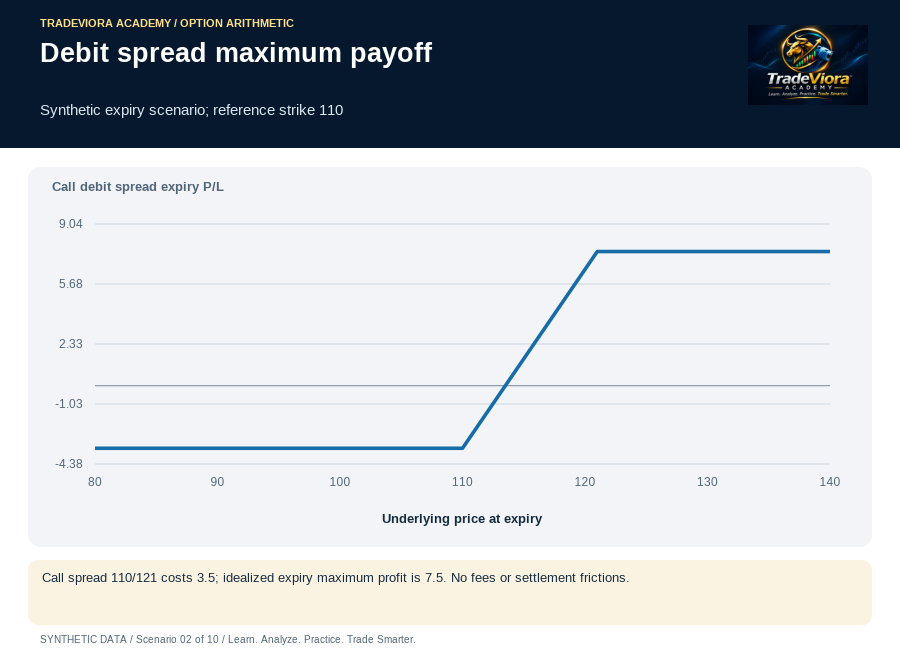
This separate synthetic case illustrates the arithmetic behind the topic. Its invented inputs are independent of the worked example above.
Download this concept’s cheat sheet · Run the related Python example · Explore scenario illustrations