
FREE FINANCIAL EDUCATION
Protective put
Construct the expiry floor of a matched stock-plus-put position.
What you will learn
Prerequisites: Long stock and purchased-put payoffs; contract unit matching.
- Construct the expiry floor of a matched stock-plus-put position.
- Calculate the premium-inclusive maximum loss.
- Identify the gap between hedge expiry and the investor’s holding horizon.
Mechanism and decision rules
A protective put combines a long underlying holding with a long put on the same underlying and matching units. At the put’s expiry, stock value plus put payoff is S + max(K − S, 0), which equals max(S, K). This produces a floor of K before considering initial costs, fees and settlement details. The put premium is the price paid for that convex protection.
The floor applies to the specified expiry and reference, not to every displayed mark before expiry or every future date. A different underlying introduces basis risk; fewer put units leave part of the holding unprotected. If the investor retains the stock beyond option expiry, the floor ends unless a new hedge is acquired. Repeatedly renewing insurance changes long-run returns through cumulative premium costs.
Worked example · synthetic data
Synthetic stock is bought at ₹100 and a strike-95 put costs ₹3. Total initial cost is ₹103 per unit. If expiry S = ₹80, stock value is ₹80 and the put pays ₹15, leaving combined value ₹95 and profit −₹8. If S = ₹120, the put expires without intrinsic value and combined profit is ₹17.
The maximum expiry loss is 100 + 3 − 95 = ₹8 per unit, and upside breakeven is ₹103 before costs. The first ₹5 stock decline and the ₹3 insurance premium together explain the loss floor.
Failure modes and limits
The floor is a payoff identity under matched terms, not a promise about pre-expiry liquidation spreads or broker operations. Physical settlement can require specific delivery instructions. An index put covering a stock portfolio creates an imperfect hedge, and the selected strike may leave a meaningful first-loss region.
Practice case
Buy stock at ₹500 and a strike-470 put for ₹12. Calculate maximum expiry loss and P&L at settlement ₹430 and ₹540. Assume matched units and ignore costs.
Reveal the worked answer
Initial cost is ₹512 and minimum expiry value is ₹470, so maximum loss is ₹42 per unit. At ₹430, stock plus put is 430 + 40 = 470, giving −42. At ₹540, the put has zero intrinsic value, so profit is 540 − 512 = ₹28.
Check your understanding
Sources and next steps
The lesson, calculations and synthetic cases are original educational material. References explain underlying contract or chart conventions; none validates the profitability of a trading rule. Actual contract specifications, settlement obligations and charges must be checked before trading.
Explore OHLCV data in the chart lab · Explore volume-at-price and TPO data · Practice library
Related quantitative practice
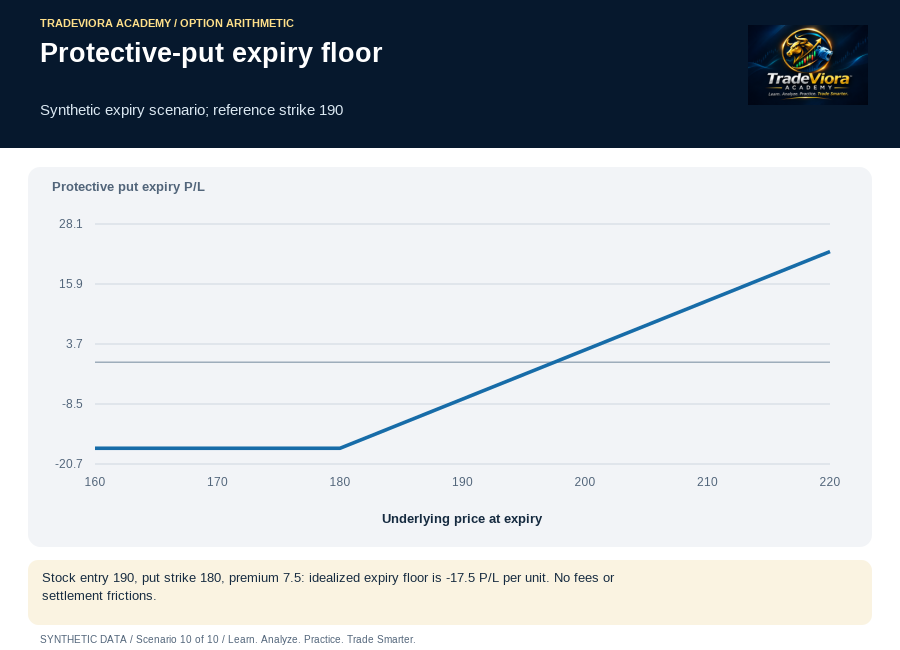
This separate synthetic case illustrates the arithmetic behind the topic. Its invented inputs are independent of the worked example above.
Download this concept’s cheat sheet · Explore scenario illustrations