
FREE FINANCIAL EDUCATION
Covered call
Combine stock and short-call payoffs without counting premium twice.
What you will learn
Prerequisites: Stock P&L, call payoff and matching option contract units.
- Combine stock and short-call payoffs without counting premium twice.
- Calculate capped upside and downside breakeven.
- Explain why owning the stock does not eliminate its downside risk.
Mechanism and decision rules
A covered call pairs a long underlying position with a short call on the same underlying and matching units. The stock supports the delivery or economic obligation associated with the short call. The premium provides a limited cushion, while the short call gives up gains above the strike. “Covered” describes the call obligation; it does not mean the stock investment is protected against a large decline.
At expiry, per-unit profit is S − stock entry + premium received − max(S − K, 0), before costs and distributions. Above K, the stock gain and call loss offset, leaving capped profit. Below K, the short call expires without intrinsic value, but the stock continues to lose as S falls. Settlement form and exercise style determine how the combined position is actually managed.
Worked example · synthetic data
In a synthetic example, buy stock at ₹100 and sell a strike-110 call for ₹4. At expiry S = ₹120, stock profit is ₹20 and the short call loses ₹10 intrinsic while retaining ₹4 premium; combined profit is ₹14. At S = ₹90, the stock loses ₹10 and the call contributes ₹4, leaving −₹6.
Maximum expiry profit is 110 − 100 + 4 = ₹14 per unit. Breakeven is ₹96. For an underlying bounded at zero, the downside can reach ₹96 per unit, so the ₹4 premium is a small cushion relative to the remaining risk.
Failure modes and limits
An unmatched option unit size can leave part of the call uncovered or part of the stock unpaired. Early assignment matters where American exercise applies; Indian product rules must be checked separately. Dividends, taxes, delivery and transaction costs change results. Selling an additional call after the stock is sold creates a different, potentially uncovered exposure.
Practice case
Stock entry is ₹250, short-call strike ₹270 and premium ₹8. Calculate expiry P&L at ₹240 and ₹290, plus breakeven and maximum profit per unit.
Reveal the worked answer
At ₹240, P&L is −10 + 8 = −₹2. At ₹290, P&L is 40 + 8 − 20 = ₹28. Breakeven is ₹242; maximum profit is 270 − 250 + 8 = ₹28. Upside beyond ₹270 accrues to the call holder economically, before implementation effects.
Check your understanding
Sources and next steps
The lesson, calculations and synthetic cases are original educational material. References explain underlying contract or chart conventions; none validates the profitability of a trading rule. Actual contract specifications, settlement obligations and charges must be checked before trading.
Explore OHLCV data in the chart lab · Explore volume-at-price and TPO data · Practice library
Related quantitative practice
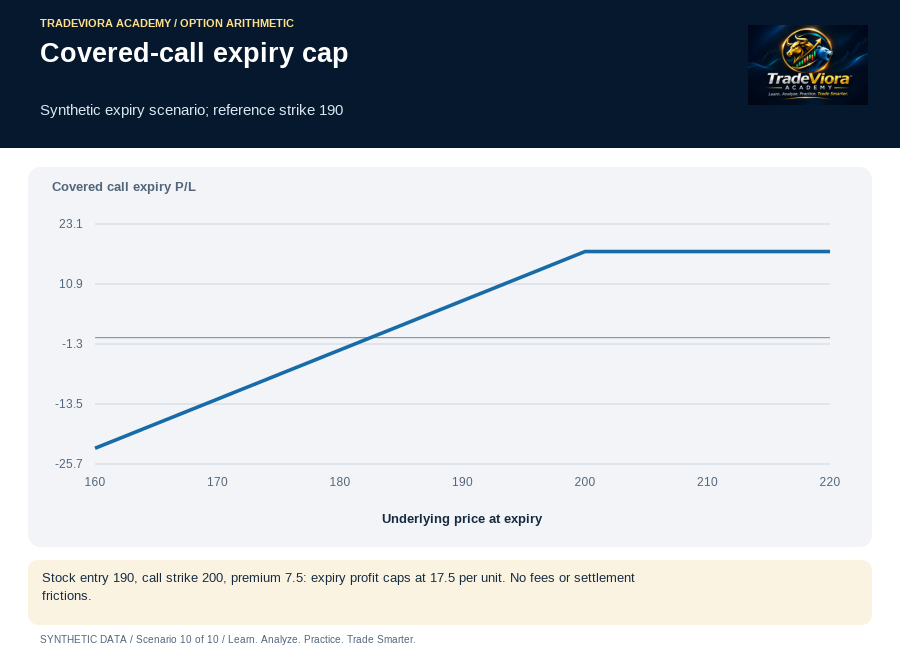
This separate synthetic case illustrates the arithmetic behind the topic. Its invented inputs are independent of the worked example above.
Download this concept’s cheat sheet · Explore scenario illustrations