
FREE FINANCIAL EDUCATION
Margin and leverage
Distinguish required collateral, available cash and economic exposure.
What you will learn
Prerequisites: Notional exposure, account equity and daily settlement cash flows.
- Distinguish required collateral, available cash and economic exposure.
- Measure the effect of a margin increase after an adverse move.
- Explain why maximum broker buying power is not a position-size target.
Mechanism and decision rules
Margin is collateral required to support an open derivatives position. It is separate from the contract’s notional exposure and separate from the account’s risk budget. Initial, ongoing and additional requirements depend on exchange, clearing and broker rules; they can change as volatility, concentration or expiry obligations change. A spread can receive an offset that disappears if a leg is closed or expires.
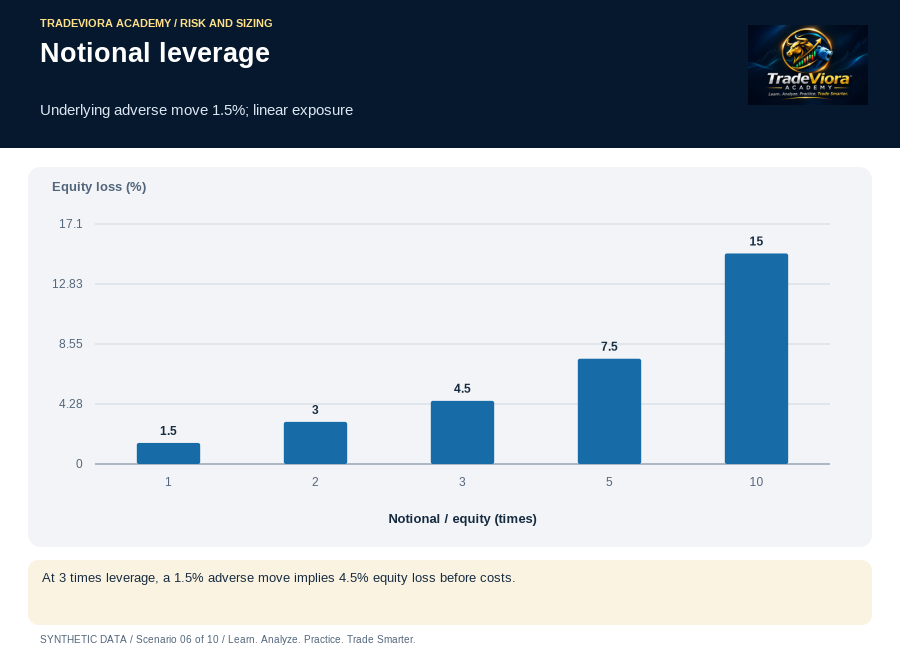
Leverage comes from controlling a notional amount larger than the capital supporting it. A small percentage move in the contract can therefore be a large percentage move in account equity. Cash is also needed to meet settlement losses. A position may be economically attractive over a longer horizon yet be forced out because its owner cannot meet a near-term collateral call. Solvency in a final scenario and liquidity along the path are different problems.
Worked example · synthetic data
A fictional future has ₹500,000 notional and requires ₹75,000 initial collateral. An account with ₹120,000 equity buys one contract, leaving ₹45,000 beyond that illustrative requirement. A 4% adverse move causes a ₹20,000 loss, reducing equity to ₹100,000.
If the required margin simultaneously rises to ₹90,000, the remaining cushion is only ₹10,000. The loss is 16.67% of starting account equity, despite a 4% contract move. Calling the original ₹75,000 margin the maximum loss would be incorrect.
Failure modes and limits
These percentages are fictional, not current exchange margin rates. Brokers may require more than clearing minimums and may liquidate positions under their terms. Collateral assets can have haircuts and may not satisfy every cash requirement. An offsetting position does not guarantee margin relief or eliminate the need for a liquidity reserve.
Practice case
Equity is ₹200,000 and required margin is ₹120,000. After ₹30,000 settlement losses, margin rises to ₹150,000. Compute remaining equity and cushion. Why is the original ₹80,000 cushion no longer relevant?
Reveal the worked answer
Equity becomes ₹170,000 and the new cushion is ₹20,000. The original cushion ignored both the realized settlement loss and the higher requirement. A cash-flow plan must recompute these quantities as conditions change; it cannot rely on the opening margin snapshot.
Check your understanding
Sources and next steps
The lesson, calculations and synthetic cases are original educational material. References explain underlying contract or chart conventions; none validates the profitability of a trading rule. Actual contract specifications, settlement obligations and charges must be checked before trading.
Explore OHLCV data in the chart lab · Explore volume-at-price and TPO data · Practice library
Related quantitative practice
This separate synthetic case illustrates the arithmetic behind the topic. Its invented inputs are independent of the worked example above.
Download this concept’s cheat sheet · Explore scenario illustrations