
FREE FINANCIAL EDUCATION
Notional exposure
Compute gross and net futures notional for multiple positions.
What you will learn
Prerequisites: Futures contract multiplier, signed positions and account equity.
- Compute gross and net futures notional for multiple positions.
- Translate a percentage market move into approximate account impact.
- Explain why offsetting notionals do not eliminate basis risk.
Mechanism and decision rules
Futures notional is quoted price × multiplier × number of contracts. Signed notional is positive for a long and negative for a short. Gross notional sums absolute exposures, while net notional sums signed exposures. These measures answer different questions: gross indicates the scale of positions, while net is a coarse directional summary.
For a linear contract, a small percentage move in the underlying price produces approximately the same percentage change in notional P&L before basis and currency effects. Dividing gross or net notional by account equity gives a leverage measure, but neither is a complete risk model. A long equity-index future and a short commodity future do not form a neutral portfolio merely because their notionals match. Even near and far expiries of the same underlying can diverge.
Worked example · synthetic data
A synthetic account has ₹150,000 equity. It holds two long futures at 20,000 with a ₹10 multiplier: long notional is ₹400,000. It also holds one short next-month future at 20,100 with the same multiplier: short notional is −₹201,000. Gross notional is ₹601,000 and net notional is ₹199,000.
Gross leverage is 601,000/150,000 ≈ 4.01 times; net leverage is about 1.33 times. If both contract prices fall exactly 1%, approximate combined P&L is −₹4,000 + ₹2,010 = −₹1,990. Different changes in the two expiries would alter this result.
Failure modes and limits
Notional is a scale measure, not a worst-case loss. Gross notional overstates directional exposure for some hedges but can reveal operational size hidden by netting. Currency conversion, multiplier differences, basis changes and nonlinear options invalidate simplistic aggregation. Report what is being netted and why the offset assumption is reasonable.
Practice case
An account with ₹100,000 equity holds a ₹300,000 long future and a ₹280,000 short future in another expiry of the same underlying. Calculate gross and net leverage. What risk remains even when net exposure looks small?
Reveal the worked answer
Gross leverage is ₹580,000/₹100,000 = 5.8 times; net leverage is ₹20,000/₹100,000 = 0.2 times. Relative expiry pricing, liquidity, margin and settlement cash flows remain. A near-zero net number does not ensure both legs can be closed together at the assumed prices.
Check your understanding
Sources and next steps
The lesson, calculations and synthetic cases are original educational material. References explain underlying contract or chart conventions; none validates the profitability of a trading rule. Actual contract specifications, settlement obligations and charges must be checked before trading.
Explore OHLCV data in the chart lab · Explore volume-at-price and TPO data · Practice library
Related quantitative practice
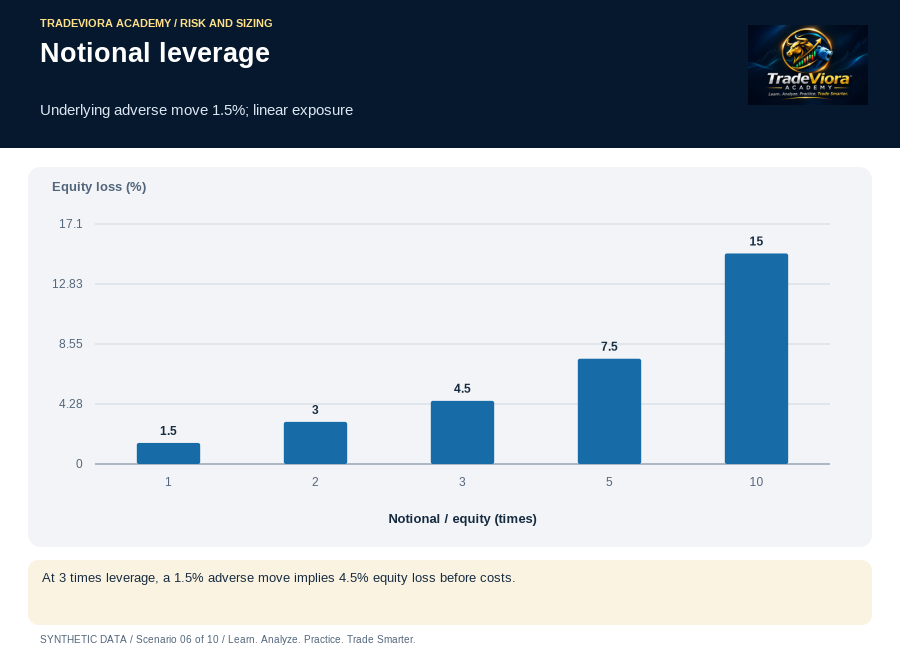
This separate synthetic case illustrates the arithmetic behind the topic. Its invented inputs are independent of the worked example above.
Download this concept’s cheat sheet · Explore scenario illustrations