
FREE FINANCIAL EDUCATION
Mark to market
Calculate sequential settlement variation without double-counting earlier gains.
What you will learn
Prerequisites: Futures multipliers, long and short P&L and account cash accounting.
- Calculate sequential settlement variation without double-counting earlier gains.
- Reconcile daily cash flows to total entry-to-exit P&L.
- Distinguish the settlement reference from the last displayed trade.
Mechanism and decision rules
Daily mark to market transfers futures gains and losses using the applicable settlement price. After settlement, the next day’s calculation uses that reset reference rather than repeatedly measuring from the original entry. For a long, positive price change produces a gain; for a short, the sign reverses. Contract multiplier and quantity translate points into money.
The daily settlement price is established under the venue’s rules and need not equal the final displayed transaction. Intraday open and closed trades require the appropriate trade-to-settlement or trade-to-exit calculations. Keep three records distinct: position, cash movements, and economic P&L. Cumulative settlement cash plus the remaining unsettled change should reconcile to entry-to-current economic P&L before fees.
Worked example · synthetic data
A fictional long future has a multiplier of ₹50 per point. Entry is 1,000. Day one settles at 1,012, producing +₹600. Day two settles at 1,005, producing (1,005 − 1,012) × 50 = −₹350. The position exits on day three at 1,009, adding +₹200 from the last settlement reference.
Total is 600 − 350 + 200 = ₹450, equal to (1,009 − 1,000) × 50. Calculating every day’s movement from 1,000 and then summing those figures would double-count changes already settled.
Failure modes and limits
Settlement calendars, payment deadlines and final settlement calculations are venue-specific and can change. Do not equate an accounting gain with immediately withdrawable cash. Margin and settlement variation are separate cash needs. Delivery-based expiry obligations require additional accounting beyond this simplified closed-before-expiry example.
Practice case
A short contract with multiplier ₹20 is entered at 500. It settles first at 490, then 495, and is covered at 492. Calculate the three cash-flow components and total gross P&L.
Reveal the worked answer
The short gains (500 − 490) × 20 = ₹200, then loses (490 − 495) × 20 = −₹100, then gains (495 − 492) × 20 = ₹60. Total is ₹160, matching (500 − 492) × 20. The reset reference changes; the trade’s economic total does not.
Check your understanding
Sources and next steps
The lesson, calculations and synthetic cases are original educational material. References explain underlying contract or chart conventions; none validates the profitability of a trading rule. Actual contract specifications, settlement obligations and charges must be checked before trading.
Explore OHLCV data in the chart lab · Explore volume-at-price and TPO data · Practice library
Related quantitative practice
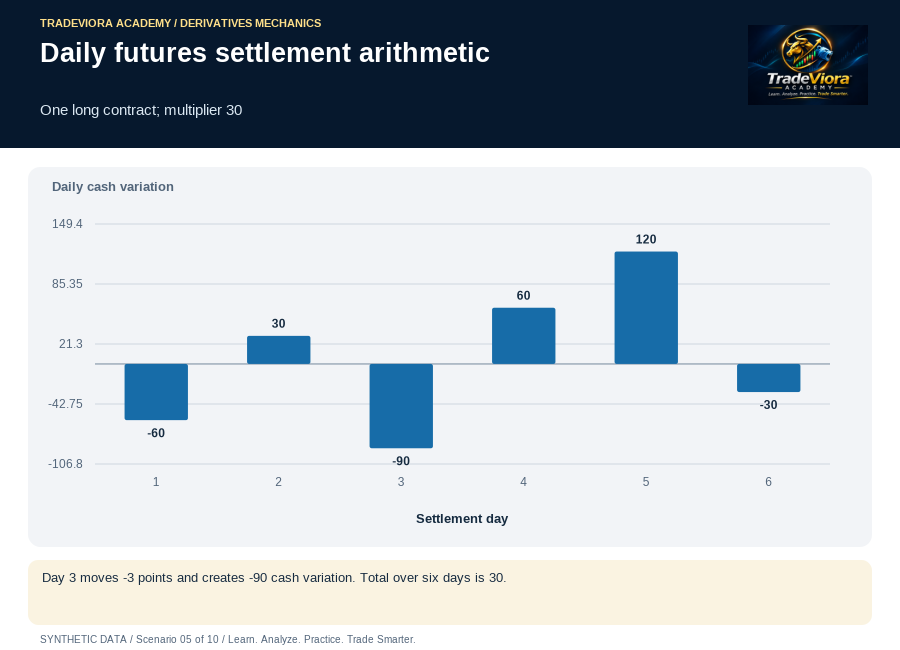
This separate synthetic case illustrates the arithmetic behind the topic. Its invented inputs are independent of the worked example above.
Download this concept’s cheat sheet · Run the related Python example · Explore scenario illustrations