
FREE FINANCIAL EDUCATION
VWAP mean reversion
Express a mean-reversion hypothesis as deviation, re-entry and invalidation rules.
What you will learn
Prerequisites: VWAP calculation; long and short P&L; entry versus invalidation conditions.
- Express a mean-reversion hypothesis as deviation, re-entry and invalidation rules.
- Calculate remaining upside after a late fill.
- Explain why distance from VWAP is insufficient evidence of reversal.
Mechanism and decision rules
A VWAP reversion hypothesis expects a temporary price deviation to narrow. It differs from simply buying whenever price looks low. A complete specification names the reference VWAP, deviation measure, trigger, invalidation and maximum holding time. A trigger might require a completed bar to return inside a predeclared band after an excursion. That changes the strategy from predicting the extreme to reacting after a return has begun.
The reference itself moves. A selloff with substantial new volume may pull VWAP lower, so a trade can appear closer to VWAP because the benchmark moved toward the position. Record entry-time VWAP separately from developing VWAP and specify which controls the exit. Large deviations can persist during news-driven repricing or a directional auction; “far from average” is not a mechanical cause of reversal.
Worked example · synthetic data
Synthetic entry-time VWAP is ₹250. Price falls to ₹245, then a completed bar closes back above a defined ₹246 band. The plan buys at ₹246.50, stops at ₹244.50 and targets the fixed entry-time VWAP of ₹250. Gross risk is ₹2 and gross reward is ₹3.50, a 1.75:1 ratio.
If execution slips to ₹248, the same stop and target produce ₹3.50 risk against ₹2 reward, only 0.57:1. An entry rule that ignores the maximum acceptable fill can transform the intended trade. The original signal alone does not justify every subsequent entry price.
Failure modes and limits
Volatility bands are model conventions; a two-standard-deviation distance is not a promise that price must return. A session with structural news may establish a new value region. Repeated averaging down changes both exposure and the rule. Do not use a later-developing VWAP to judge whether an earlier target was available.
Practice case
Entry is ₹98, stop ₹96 and fixed VWAP target ₹101. The order actually fills at ₹99.50. Compare the planned and actual gross reward-to-risk ratios. If the minimum permitted ratio is 1.2, does the late fill qualify?
Reveal the worked answer
Planned reward/risk is 3/2 = 1.5. At ₹99.50, it is 1.5/3.5 ≈ 0.43. The late fill fails the declared 1.2 minimum. An implementation should encode the permissible fill or order limit before submission; a rule cannot retroactively undo an already executed order.
Check your understanding
Sources and next steps
The lesson, calculations and synthetic cases are original educational material. References explain underlying contract or chart conventions; none validates the profitability of a trading rule. Actual contract specifications, settlement obligations and charges must be checked before trading.
Explore OHLCV data in the chart lab · Explore volume-at-price and TPO data · Practice library
Related quantitative practice
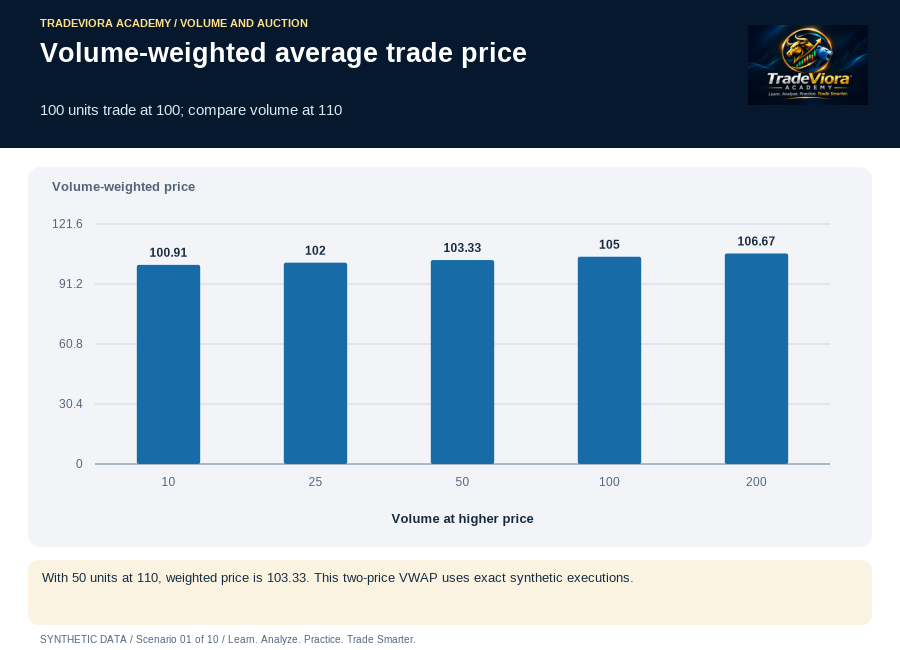
This separate synthetic case illustrates the arithmetic behind the topic. Its invented inputs are independent of the worked example above.
Download this concept’s cheat sheet · Run the related Python example · Explore scenario illustrations