FREE FINANCIAL EDUCATION
Gap analysis
Calculate a signed opening gap and distinguish it from a gap outside the prior range.
What you will learn
Prerequisites: Percentage change, previous close versus prior range, corporate-action adjustments.
- Calculate a signed opening gap and distinguish it from a gap outside the prior range.
- Normalize a gap by a predefined volatility measure.
- Recognize when a corporate action breaks an unadjusted comparison.
Mechanism and decision rules
An opening gap relative to the previous close is (open − previous close)/previous close. A positive value is an up gap. An open above the previous close can still be inside yesterday’s high–low range, which is a different location from an open above the prior high. Label the reference explicitly rather than using “gap up” as a complete market description.
To compare instruments or volatility regimes, divide the absolute gap by a volatility measure known before the open, such as yesterday’s finalized average true range. This creates a descriptive scale, not a forecast. Then separate the observation from the hypothesis: continuation, fade, or no trade. Earnings, overnight market moves, dividends and data errors have different implications. A split can create a large numerical discontinuity in unadjusted prices without a comparable economic loss.
Worked example · synthetic data
A synthetic security closes at ₹400, with prior high ₹408 and low ₹394. It opens at ₹406. The signed gap is 6/400 = 1.5%, but the open remains inside the previous range. If the finalized ATR is ₹8, the gap is 0.75 ATR.
A second security closes at ₹400 before a two-for-one split and opens near ₹200 on the adjusted share basis. Calling that an economic 50% overnight crash is misleading. Either compare consistently adjusted prices for research or explicitly model the corporate action in raw-price accounting.
Failure modes and limits
An official opening auction price and the first continuous-market trade may differ. Data vendors can use different session definitions and adjustment policies. Never use today’s full-session ATR in an opening decision. Gap size alone does not establish a fill probability, and a “gap fill” needs a precise target and time horizon.
Practice case
Previous close is ₹250, high ₹256 and low ₹246. The open is ₹258; prior finalized ATR is ₹10. Calculate the percentage gap, ATR-normalized gap and opening location relative to the previous range.
Reveal the worked answer
The gap is ₹8, or 8/250 = 3.2%. Its size is 0.8 ATR. Because ₹258 exceeds ₹256, this is an open above the prior range, not merely above the prior close. Those three labels describe different aspects of the same opening event.
Check your understanding
Sources and next steps
The lesson, calculations and synthetic cases are original educational material. References explain underlying contract or chart conventions; none validates the profitability of a trading rule. Actual contract specifications, settlement obligations and charges must be checked before trading.
Explore OHLCV data in the chart lab · Explore volume-at-price and TPO data · Practice library
Related quantitative practice
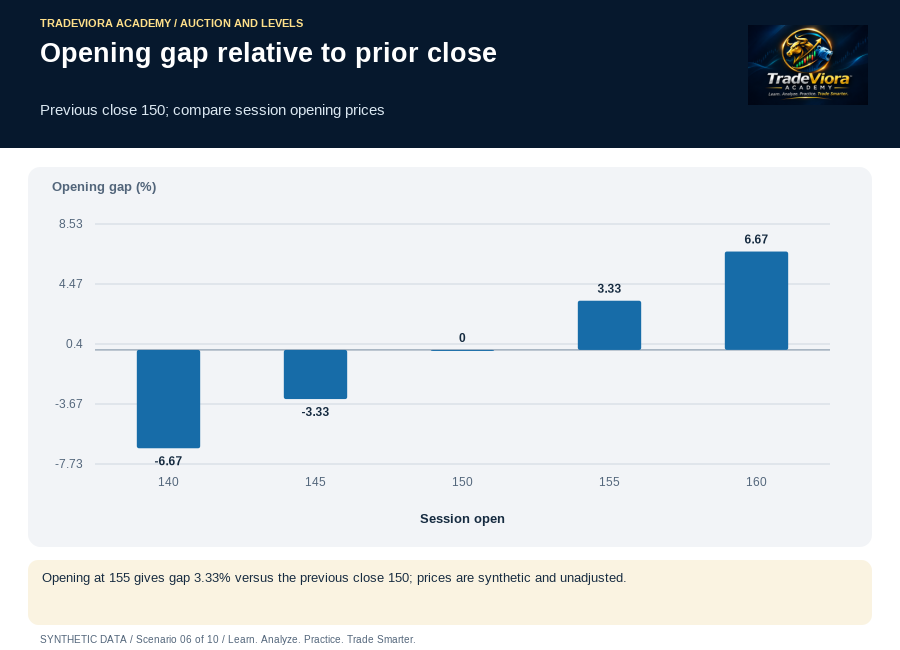
This separate synthetic case illustrates the arithmetic behind the topic. Its invented inputs are independent of the worked example above.
Download this concept’s cheat sheet · Try the related calculator · Explore scenario illustrations
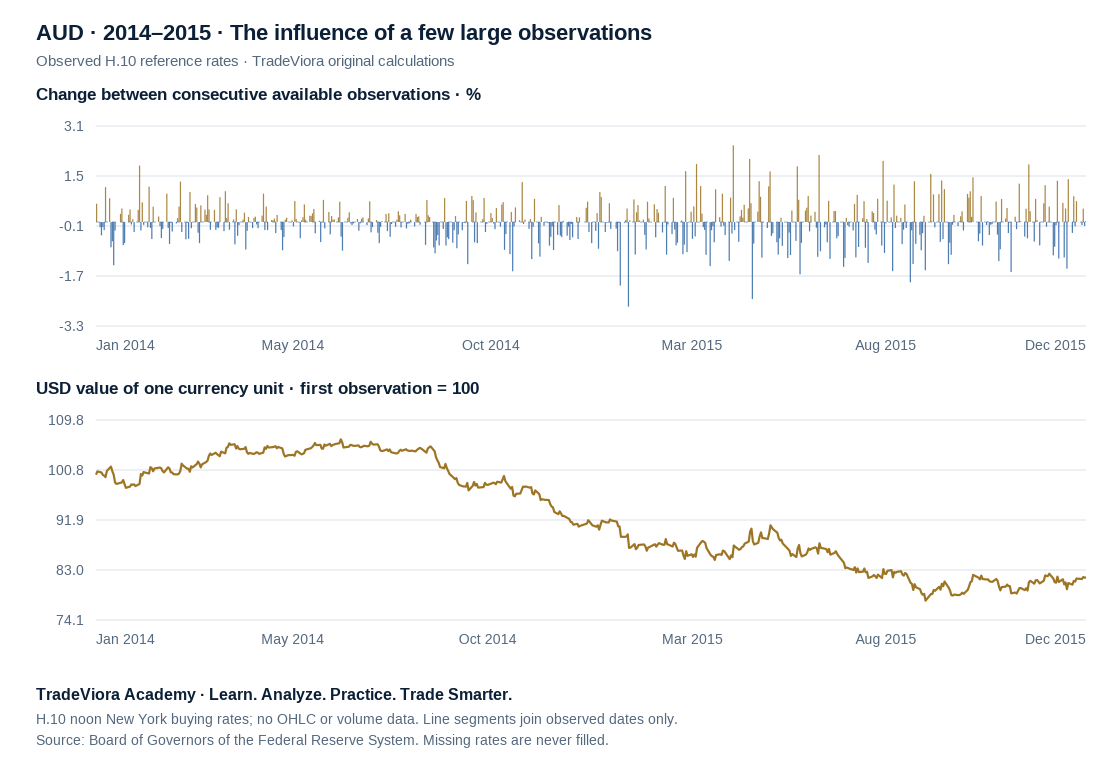
Apply the measurement to genuine historical data
Australian dollar, 2014–2015: the influence of a few large observations uses Federal Reserve H.10 reference-rate observations. It is an FX measurement exercise, not a test of a trading strategy or an OHLC candlestick record.