
FREE FINANCIAL EDUCATION
VWAP trend filter
Calculate session VWAP from price–quantity observations.
What you will learn
Prerequisites: Weighted averages, session boundaries and observable entry rules.
- Calculate session VWAP from price–quantity observations.
- Use a VWAP filter without mistaking it for a standalone signal.
- Identify the timing error in applying end-of-day VWAP intraday.
Mechanism and decision rules
Volume-weighted average price is Σ(price × quantity) / Σquantity over a specified interval. With actual trade records, each execution contributes its price and size. A bar approximation often substitutes a representative bar price, so it need not equal transaction-level VWAP. Session VWAP resets at the stated boundary; an anchored VWAP instead starts at a chosen event.
A trend filter restricts eligible trades, for example allowing long breakouts only while the last completed close is above the contemporaneous VWAP and VWAP has risen over three completed bars. Those are two separate conditions. Price above VWAP shows location relative to accumulated volume, not certainty of an upward next move. Because earlier heavy volume remains in the denominator, VWAP can react slowly after a sharp change in conditions.
Worked example · synthetic data
Three synthetic trades occur at ₹100 for 100 units, ₹102 for 200 and ₹101 for 100. Turnover is ₹10,000 + ₹20,400 + ₹10,100 = ₹40,500; total quantity is 400; VWAP is ₹101.25. A completed close at ₹102 is above that value.
A later trade at ₹99 for 400 units moves cumulative turnover to ₹80,100 and quantity to 800, so VWAP becomes ₹100.125. A strategy at the earlier timestamp must still use ₹101.25. Replacing it with the final ₹100.125 leaks information from the later trade.
Failure modes and limits
A calculated cash index has no directly executed index volume. If a futures or ETF proxy is used, identify it explicitly. Comparisons across instruments with different sessions are unreliable. Being above VWAP can coexist with a falling VWAP and a deteriorating price trend; do not collapse separate filter conditions.
Practice case
Trades are 50 units at ₹200 and 150 at ₹204. Calculate VWAP. The latest completed close is ₹203.50, while VWAP rose from ₹202. Is a rule requiring both price above VWAP and rising VWAP satisfied?
Reveal the worked answer
VWAP = (10,000 + 30,600)/200 = ₹203. The close of ₹203.50 is above it, and ₹203 exceeds the prior ₹202, so both stated conditions pass. That merely permits evaluation of the entry signal; it does not itself define a stop, target or order.
Check your understanding
Sources and next steps
The lesson, calculations and synthetic cases are original educational material. References explain underlying contract or chart conventions; none validates the profitability of a trading rule. Actual contract specifications, settlement obligations and charges must be checked before trading.
Explore OHLCV data in the chart lab · Explore volume-at-price and TPO data · Practice library
Related quantitative practice
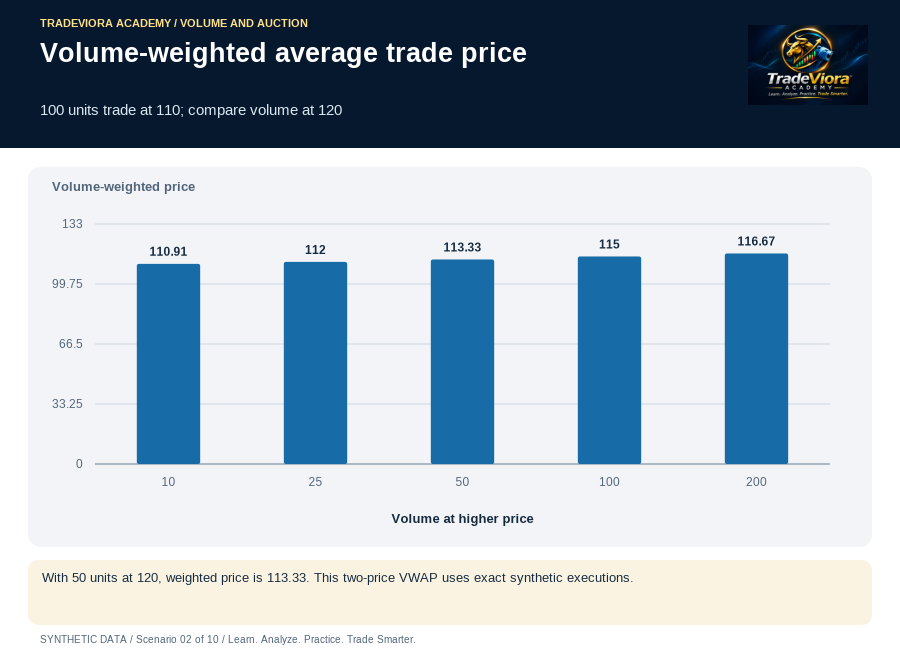
This separate synthetic case illustrates the arithmetic behind the topic. Its invented inputs are independent of the worked example above.
Download this concept’s cheat sheet · Run the related Python example · Explore scenario illustrations