FREE FINANCIAL EDUCATION
Drawdown
Calculate drawdown from the running peak rather than starting capital.
What you will learn
Prerequisites: Equity curves, percentage changes and high-water marks.
- Calculate drawdown from the running peak rather than starting capital.
- Compute the gain required to recover a given percentage loss.
- Distinguish drawdown depth from duration.
Mechanism and decision rules
Drawdown measures the decline of an equity curve from its prior running maximum. At time t, percentage drawdown is (current equity − prior peak)/prior peak, usually reported as a negative number or a positive loss magnitude. Maximum drawdown is the deepest such decline in the measured interval. It is path-dependent: two strategies with the same final return can experience very different intervening losses.
Recovery is asymmetric because gains after a loss apply to a smaller capital base. A loss fraction d requires a gain of d/(1 − d) to return to the former peak. Duration is a separate dimension: time underwater continues until the peak is regained. Specify whether equity includes open positions, withdrawals and deposits; cash flows can otherwise masquerade as investment performance.
Worked example · synthetic data
A synthetic equity path is ₹100,000, ₹120,000, ₹90,000, ₹108,000 and ₹126,000. The running peak before the low is ₹120,000. The drawdown at ₹90,000 is 30,000/120,000 = 25%, not 10% relative to initial capital. Recovery from ₹90,000 to ₹120,000 requires 33.33%.
At ₹108,000, the account is above its initial ₹100,000 but remains 10% below the former peak. The drawdown ends only when equity reaches or exceeds ₹120,000; the final ₹126,000 establishes a new peak.
Failure modes and limits
Historical maximum drawdown is not a future ceiling. Sparse observation intervals can hide intraday losses. A closed-trade equity curve can omit large open-position drawdowns. Deposits and withdrawals require a consistent return or unitization method before comparing strategies.
Practice case
An account peaks at ₹500,000, falls to ₹350,000, then rises to ₹420,000. Calculate the deepest drawdown, the required gain from the low to recover, and the remaining drawdown at ₹420,000.
Reveal the worked answer
The deepest decline is 150,000/500,000 = 30%. Recovery requires 150,000/350,000 ≈ 42.86%. At ₹420,000 the account remains 80,000/500,000 = 16% below its peak. A 20% rally from the low has not erased a 30% loss from the peak.
Check your understanding
Sources and next steps
The lesson, calculations and synthetic cases are original educational material. References explain underlying contract or chart conventions; none validates the profitability of a trading rule. Actual contract specifications, settlement obligations and charges must be checked before trading.
Explore OHLCV data in the chart lab · Explore volume-at-price and TPO data · Practice library
Related quantitative practice
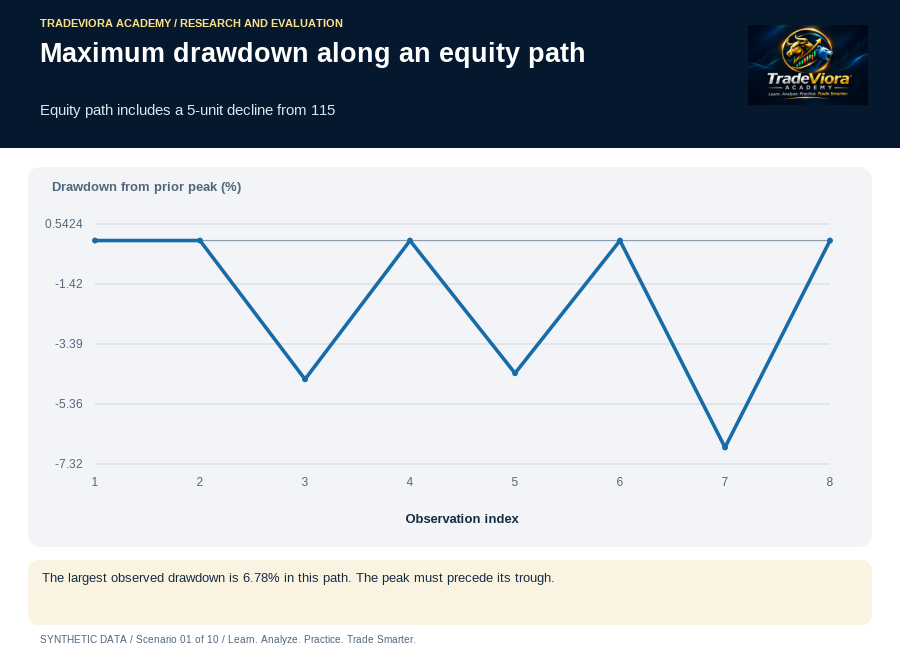
This separate synthetic case illustrates the arithmetic behind the topic. Its invented inputs are independent of the worked example above.
Download this concept’s cheat sheet · Try the related calculator · Run the related Python example · Explore scenario illustrations
Apply the measurement to genuine historical data
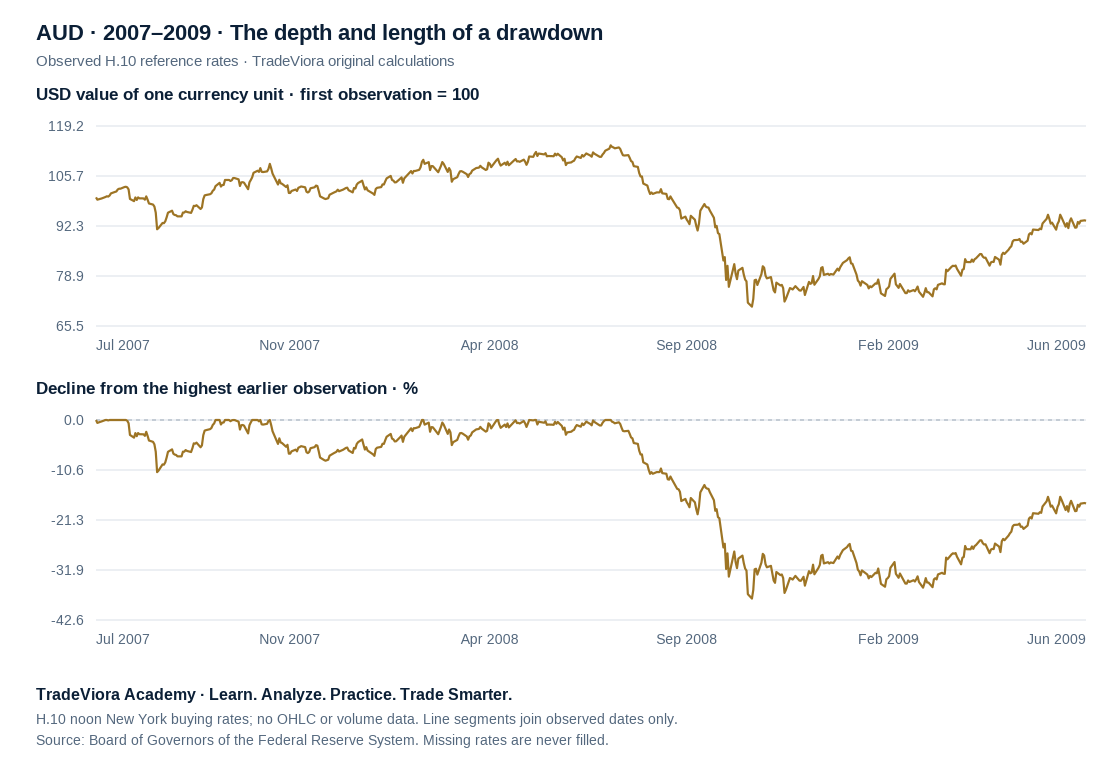
Australian dollar, 2007–2009: the depth and length of a drawdown uses Federal Reserve H.10 reference-rate observations. It is an FX measurement exercise, not a test of a trading strategy or an OHLC candlestick record.