
FREE FINANCIAL EDUCATION
Loss sequences and recovery sizing
Calculate the compounded effect of repeated fractional losses.
What you will learn
Prerequisites: Percentage returns, position-size rules and drawdown.
- Calculate the compounded effect of repeated fractional losses.
- Compare fixed-fraction and fixed-rupee risk after a drawdown.
- Explain why increasing size to recover losses changes the risk process.
Mechanism and decision rules
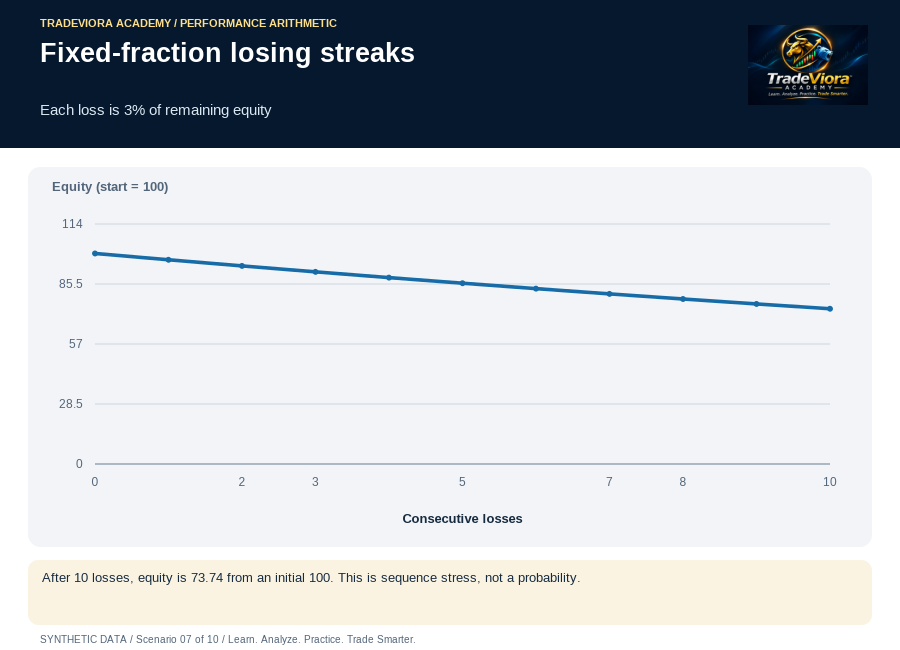
A losing sequence tests both the mathematics and the discipline of a sizing policy. If each trade loses a fixed fraction f of current equity, n consecutive losses leave E0 × (1 − f)^n under the simplified model. The monetary amount at risk shrinks as equity falls. A fixed-rupee risk policy instead becomes a larger percentage of the remaining account after losses.
Recovery pressure can lead traders to increase size precisely when their capital and confidence have weakened. Such an escalation changes the distribution of future outcomes and may invalidate the risk assumptions used to begin trading. Predefine whether a drawdown reduces size, pauses the strategy or triggers review. These rules should respond to evidence and capital constraints, not a desire to return to a particular account balance by a deadline.
Worked example · synthetic data
A synthetic ₹100,000 account risks 2% of current equity and experiences five full planned losses. Equity becomes 100,000 × 0.98^5 ≈ ₹90,392.08, a 9.61% drawdown. If instead it loses a fixed ₹2,000 each time, equity becomes ₹90,000 and the next ₹2,000 risk is 2.22% of remaining equity.
Doubling the next risk to ₹4,000 to “make it back” raises the fraction to 4.44% of ₹90,000. The previous losses do not increase the probability that the next trade wins; the larger amount simply changes the exposure.
Failure modes and limits
The formula assumes losses occur exactly at the planned fraction; gaps can exceed it. Trade outcomes may be dependent, and a run can reflect either ordinary variation or a changed process. A fixed pause threshold does not diagnose the cause by itself. Review execution, data and strategy evidence without rewriting old trade records.
Practice case
Start with ₹200,000 and lose 1% of current equity on three consecutive trades. Calculate remaining equity. If the next trade risks a fixed ₹2,000, what percentage of remaining equity is that?
Reveal the worked answer
Equity is 200,000 × 0.99^3 = ₹194,059.80. A fixed ₹2,000 risk is approximately 1.0306% of that amount, slightly above the original 1%. The difference grows as drawdown deepens; fixed rupees and fixed fractions are distinct policies.
Check your understanding
Sources and next steps
The lesson, calculations and synthetic cases are original educational material. References explain underlying contract or chart conventions; none validates the profitability of a trading rule. Actual contract specifications, settlement obligations and charges must be checked before trading.
Explore OHLCV data in the chart lab · Explore volume-at-price and TPO data · Practice library
Related quantitative practice
This separate synthetic case illustrates the arithmetic behind the topic. Its invented inputs are independent of the worked example above.
Download this concept’s cheat sheet · Explore scenario illustrations