
FREE FINANCIAL EDUCATION
Position sizing
Calculate quantity from monetary risk and per-unit loss assumptions.
What you will learn
Prerequisites: Entry price, invalidation price, costs and instrument lot size.
- Calculate quantity from monetary risk and per-unit loss assumptions.
- Round derivatives quantities down to permitted whole lots.
- Reject a trade when the minimum contract exceeds the budget.
Mechanism and decision rules
For a simple long cash position, planned price risk per share is entry minus stop. Add an explicit allowance for relevant costs and slippage, then divide the monetary risk budget by that per-unit amount and round down. The structural invalidation should define the stop; position size adapts to it. A tighter stop chosen only to increase quantity describes a different trade.
For derivatives, convert the price distance through the multiplier and lot size before rounding. Capital or margin availability is a separate constraint, so the final quantity must satisfy both risk and funding limits. A calculation based on a planned stop is a scenario, not a guarantee. If no whole lot fits the risk allowance, the correct result is zero contracts, not a rounded-up compromise.
Worked example · synthetic data
Synthetic equity is ₹300,000 and the chosen trade allowance is 0.5%, or ₹1,500. Entry is ₹240, stop ₹234 and the friction reserve is ₹1 per share. Budgeted unit risk is ₹7, so quantity is floor(1,500/7) = 214 shares. Planned budget usage is ₹1,498 and cash purchase cost is ₹51,360.
For a fictional derivative with 50 units per lot and the same ₹7 unit risk, each lot budgets ₹350. Four lots fit ₹1,400; five would require ₹1,750. The allowed size becomes 200 units, not 214.
Failure modes and limits
Slippage allowances can be exceeded, especially through gaps or thin books. Per-order fixed costs make a simple per-unit model approximate. Short equity has borrow and execution constraints, while futures and options require contract-specific risk measures. Do not use the premium alone to size an uncovered option writer’s exposure.
Practice case
Risk allowance is ₹1,000, entry–stop distance is ₹8 and friction reserve ₹2 per unit. The fictional lot contains 75 units. Compute budgeted loss per lot and maximum whole lots.
Reveal the worked answer
Per-unit budget is ₹10, so each lot uses ₹750. One lot fits; two use ₹1,500 and fail. The unused ₹250 does not justify rounding up. If the allowance were only ₹700, zero lots would fit this model.
Check your understanding
Sources and next steps
The lesson, calculations and synthetic cases are original educational material. References explain underlying contract or chart conventions; none validates the profitability of a trading rule. Actual contract specifications, settlement obligations and charges must be checked before trading.
Explore OHLCV data in the chart lab · Explore volume-at-price and TPO data · Practice library
Related quantitative practice
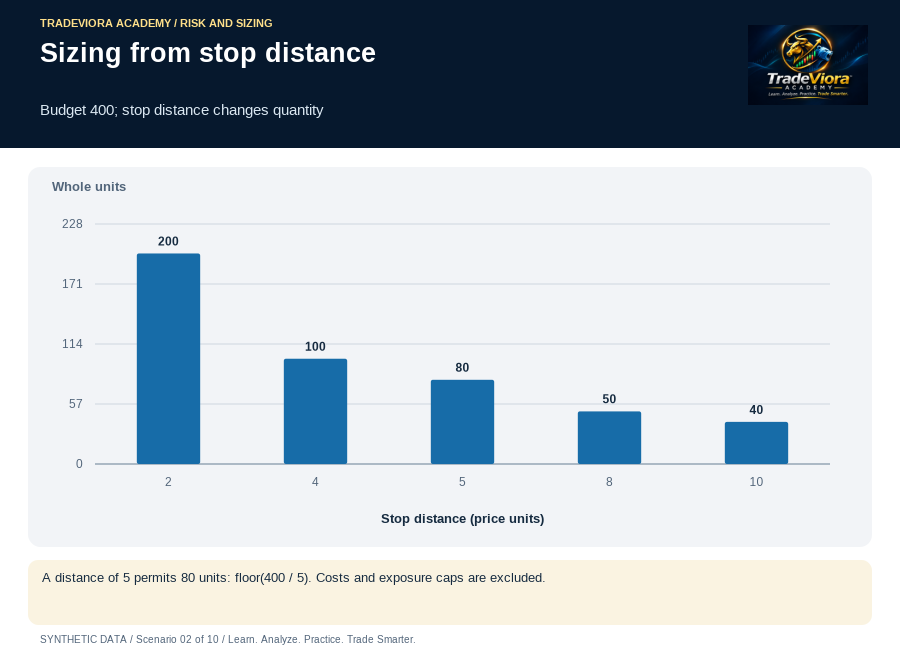
This separate synthetic case illustrates the arithmetic behind the topic. Its invented inputs are independent of the worked example above.
Download this concept’s cheat sheet · Try the related calculator · Run the related Python example · Explore scenario illustrations