
FREE FINANCIAL EDUCATION
Risk budget
Translate a portfolio-level loss allowance into per-trade capacity.
What you will learn
Prerequisites: Account equity, stop-distance loss and overlapping positions.
- Translate a portfolio-level loss allowance into per-trade capacity.
- Reserve risk for concurrent positions rather than counting each trade independently.
- Distinguish a planning budget from a guaranteed loss ceiling.
Mechanism and decision rules
A risk budget allocates how much adverse outcome an account is prepared to tolerate under specified assumptions. It can operate at trade, day, strategy and portfolio levels. These limits answer different questions and should fit together. Three trades each risking 1% can create 3% planned exposure; calling each trade small does not resolve the combined amount.
Define the denominator and update rule. Fixed initial capital, current equity and a high-water mark produce different monetary allowances after losses. Also define what consumes capacity: realized losses, open stop-distance risk, stress scenarios, fees and pending orders. A conservative workflow reserves risk before submitting an order and releases it only after state is reconciled. Correlated losses and gaps require separate stress analysis because planned stop distances may understate the joint event.
Worked example · synthetic data
A synthetic account has ₹400,000 current equity. A 0.5% per-trade cap equals ₹2,000 and a 1.5% aggregate planned-risk cap equals ₹6,000. Two open trades already reserve ₹2,000 and ₹1,500, leaving ₹2,500 of aggregate capacity. A third candidate requesting ₹2,200 fails the per-trade limit even though it fits the portfolio remainder.
A fourth candidate requesting ₹1,800 fits both limits if no other risk changes. Its acceptance still depends on correlation and stress checks; three positions in the same sector can lose together.
Failure modes and limits
No percentage is universally appropriate. A budget is only as reliable as its exit, liquidity and correlation assumptions. Raising the cap after a loss to recover more quickly changes the process precisely when capital has shrunk. Include pending and partially filled orders so reserved exposure is not silently duplicated.
Practice case
Equity is ₹250,000, per-trade cap 0.4% and aggregate cap 1.2%. Open planned risk totals ₹2,400. A candidate asks for ₹900. Does it fit both constraints?
Reveal the worked answer
The per-trade cap is ₹1,000, so ₹900 passes individually. Aggregate cap is ₹3,000 and only ₹600 remains, so it fails the combined constraint. Reduce or reject the new risk under the predeclared rules; individual eligibility does not override portfolio capacity.
Check your understanding
Sources and next steps
The lesson, calculations and synthetic cases are original educational material. References explain underlying contract or chart conventions; none validates the profitability of a trading rule. Actual contract specifications, settlement obligations and charges must be checked before trading.
Explore OHLCV data in the chart lab · Explore volume-at-price and TPO data · Practice library
Related quantitative practice
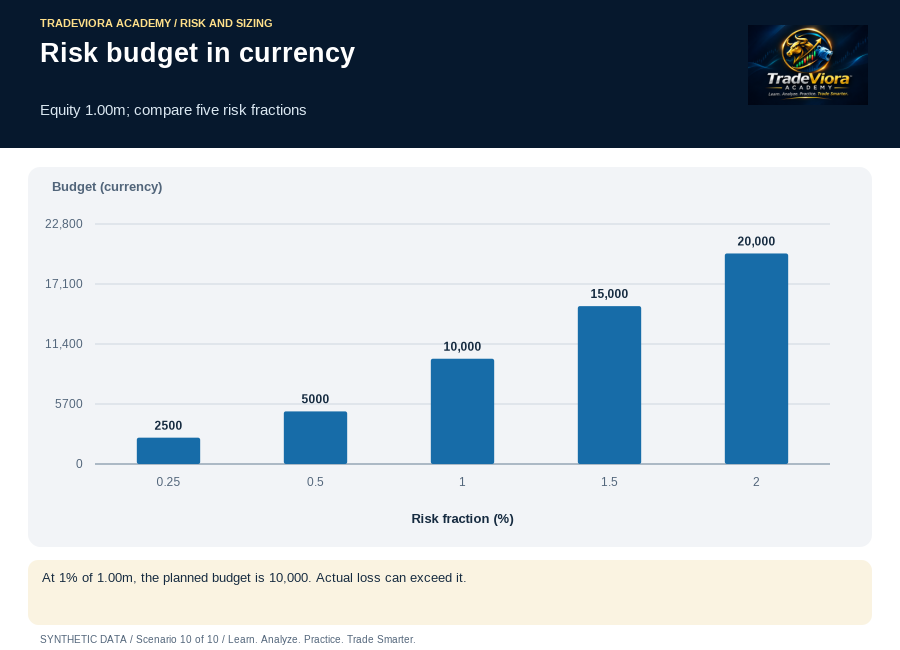
This separate synthetic case illustrates the arithmetic behind the topic. Its invented inputs are independent of the worked example above.
Download this concept’s cheat sheet · Run the related Python example · Explore scenario illustrations