
FREE FINANCIAL EDUCATION
Put options
Calculate purchased-put expiry payoff and breakeven.
What you will learn
Prerequisites: Option premium, strike and long position payoff.
- Calculate purchased-put expiry payoff and breakeven.
- Distinguish downside protection from a free guarantee.
- Explain the asymmetry between a long put and a short underlying position.
Mechanism and decision rules
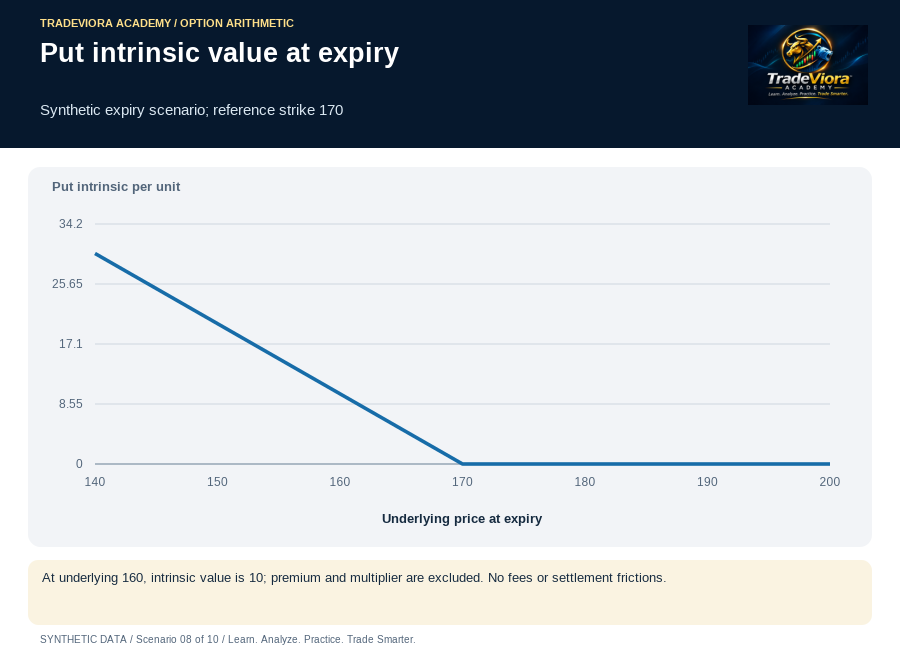
A plain put’s per-unit expiry payoff is max(K − S, 0). A purchased put’s profit subtracts its premium and costs. Breakeven before costs is K minus premium. A put can finish in the money while its buyer still loses overall because the intrinsic amount does not recover the premium.
A long put benefits from a sufficiently large decline while limiting the standalone option premium at risk. Unlike a short cash position, its payoff is nonlinear and expires. On an underlying bounded below by zero, maximum expiry payoff is K, and maximum profit is K minus premium. A put used with a cash holding can create a floor over its specified coverage period, but quantity mismatch, expiry mismatch and settlement mechanics can undermine the intended protection.
Worked example · synthetic data
A synthetic put has strike ₹200 and costs ₹9. At expiry with S = ₹180, payoff is ₹20 and profit is ₹11 per unit. At ₹195, payoff is ₹5 but profit is −₹4. At ₹210, payoff is zero and profit is −₹9. The buyer’s expiry breakeven is ₹191.
For 100 fictional units, the ₹180 outcome pays ₹2,000 against an initial ₹900 premium, leaving ₹1,100 before fees. The maximum standalone premium loss is ₹900 under the simplified payoff assumptions, not the ₹20,000 strike notional.
Failure modes and limits
Protection applies to the specified underlying, strike, quantity and expiry. A market-index put will not exactly hedge a different stock portfolio. Rolling the hedge costs additional premium, and physical delivery can require stock or cash arrangements. An inexpensive far-out-of-the-money put may leave a substantial first-loss region.
Practice case
A put has strike ₹500 and premium ₹22. With a unit size of 25, calculate expiry profit at S = ₹470 and at S = ₹490. Locate breakeven.
Reveal the worked answer
At ₹470, payoff is ₹30 and profit ₹8 per unit, or ₹200. At ₹490, payoff is ₹10 and profit −₹12 per unit, or −₹300. Breakeven is ₹478 before costs. Both outcomes are in the money, yet only the larger decline recovers the premium.
Check your understanding
Sources and next steps
The lesson, calculations and synthetic cases are original educational material. References explain underlying contract or chart conventions; none validates the profitability of a trading rule. Actual contract specifications, settlement obligations and charges must be checked before trading.
Explore OHLCV data in the chart lab · Explore volume-at-price and TPO data · Practice library
Related quantitative practice
This separate synthetic case illustrates the arithmetic behind the topic. Its invented inputs are independent of the worked example above.
Download this concept’s cheat sheet · Explore scenario illustrations