
FREE FINANCIAL EDUCATION
Call options
Compute long-call expiry payoff and net profit separately.
What you will learn
Prerequisites: Option contract units, strike and expiry payoff versus premium.
- Compute long-call expiry payoff and net profit separately.
- Locate the expiry breakeven of a purchased call.
- Explain why a correct directional view can still lose money.
Mechanism and decision rules
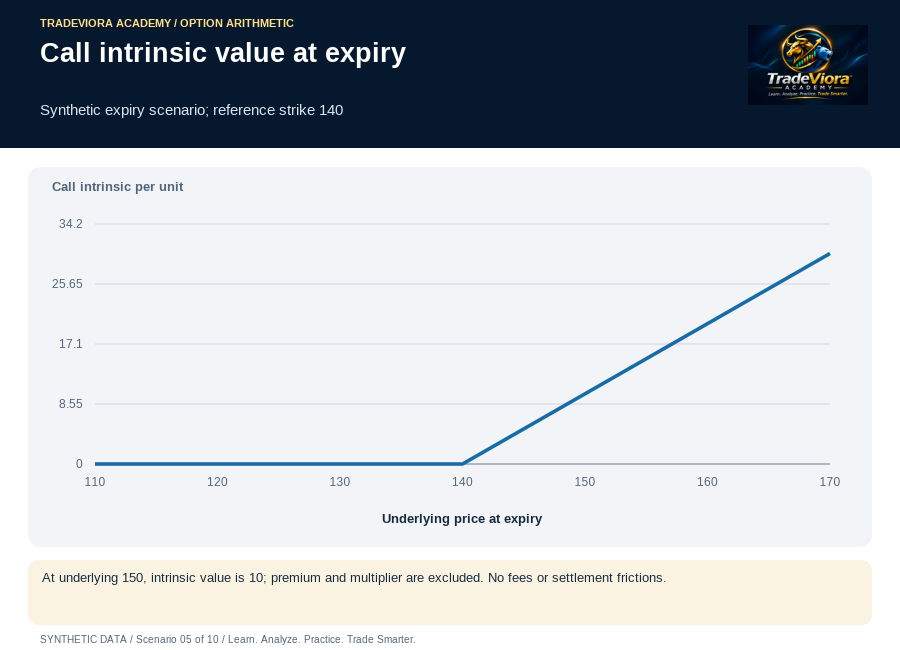
At expiry, a plain call’s per-unit intrinsic payoff is max(S − K, 0), where S is the specified settlement reference and K is strike. A purchased call’s expiry profit subtracts the premium paid and costs. The payoff cannot be negative, but profit can. Ignoring costs, breakeven is strike plus premium; merely finishing above strike is insufficient to make the buyer profitable.
Before expiry, an option can retain time value, and its traded price responds to volatility, time, rates and underlying changes. Therefore the expiry breakeven is not a universal exit-price rule for earlier dates. A long call has limited premium loss in the simplified standalone payoff model and uncapped upside as the underlying rises, but a low probability of a sufficiently large move may still produce poor expected outcomes.
Worked example · synthetic data
A synthetic call has strike ₹100 and premium ₹7. At expiry with S = ₹112, payoff is ₹12 and profit is ₹5 per unit. At S = ₹104, payoff is ₹4 but profit is −₹3. At S = ₹98, payoff is zero and profit is −₹7. Expiry breakeven is ₹107 before fees.
For a fictional unit size of 50, the ₹112 outcome produces ₹250 gross profit after premium: 50 × 5. A premium quote of ₹7 must not be mistaken for the total contract cost of ₹350.
Failure modes and limits
The maximum-premium-loss statement assumes a standalone long option before any exercised delivery position and excludes charges. A call bought before an event may lose value after a volatility decline even if the underlying rises modestly. Illiquid quotes and wide spreads can overwhelm a small modeled advantage.
Practice case
A call has strike ₹250 and costs ₹14 per unit. At expiry the settlement reference is ₹260, and the unit size is 40. Calculate payoff, profit and breakeven before fees.
Reveal the worked answer
Payoff is ₹10 per unit, so the contract pays ₹400. Profit is 10 − 14 = −₹4 per unit, or −₹160 for 40 units. Breakeven is ₹264. The underlying finished above strike, but not far enough above it to recover the premium.
Check your understanding
Sources and next steps
The lesson, calculations and synthetic cases are original educational material. References explain underlying contract or chart conventions; none validates the profitability of a trading rule. Actual contract specifications, settlement obligations and charges must be checked before trading.
Explore OHLCV data in the chart lab · Explore volume-at-price and TPO data · Practice library
Related quantitative practice
This separate synthetic case illustrates the arithmetic behind the topic. Its invented inputs are independent of the worked example above.
Download this concept’s cheat sheet · Explore scenario illustrations