
FREE FINANCIAL EDUCATION
Value area high and low
Construct a contiguous value area using an explicit expansion algorithm.
What you will learn
Prerequisites: Volume profiles, VPOC, cumulative percentages and bin adjacency.
- Construct a contiguous value area using an explicit expansion algorithm.
- Calculate why included volume can exceed the target percentage.
- Explain why value area is descriptive rather than a statistical confidence interval.
Mechanism and decision rules
A volume value area is a selected region containing at least a specified share of profile volume, commonly 70% by platform convention. It is not uniquely determined by the percentage alone. Platforms differ in how they expand from VPOC, compare adjacent rows and resolve ties. Record the algorithm, row size and session before comparing boundaries.
For this lesson, start with the unique VPOC, compare the next unselected row above and below, add the one with greater volume, and repeat until cumulative volume reaches the target. On equal candidates, add both. Included whole rows can overshoot the target. The highest included price is VAH and the lowest is VAL. The resulting contiguous region is not a normal-distribution confidence interval and carries no guaranteed future containment probability.
Worked example · synthetic data
Synthetic rows from low to high are 100:10, 101:20, 102:40, 103:25 and 104:5 units, totaling 100. The 70% target is 70 units. Start at VPOC 102 with 40. Adjacent candidates are 101 with 20 and 103 with 25; include 103, reaching 65. Next candidates are 101 with 20 and 104 with 5; include 101, reaching 85.
Under this stated algorithm, VAL = 101 and VAH = 103, with 85% of volume included. It is incorrect to force exactly 70 by silently slicing a row or selecting noncontiguous bins.
Failure modes and limits
Other charting algorithms can legitimately produce different boundaries. A larger bin makes overshoot more likely. Value-area levels change as a session develops, and the final area is unavailable earlier. A price outside value is a location description, not a sufficient reason to fade or follow it.
Practice case
Rows 10:10, 11:35, 12:30, 13:15 and 14:10 total 100. Using the stated one-row expansion rule and a 70% target, find VPOC, included rows, VAL and VAH.
Reveal the worked answer
Start at 11 with 35. Compare 10 with 10 units and 12 with 30; add 12, reaching 65. Compare 10 with 10 and 13 with 15; add 13, reaching 80. VPOC is 11, included rows are 11–13, VAL is 11 and VAH is 13.
Check your understanding
Sources and next steps
The lesson, calculations and synthetic cases are original educational material. References explain underlying contract or chart conventions; none validates the profitability of a trading rule. Actual contract specifications, settlement obligations and charges must be checked before trading.
Explore OHLCV data in the chart lab · Explore volume-at-price and TPO data · Practice library
Related quantitative practice
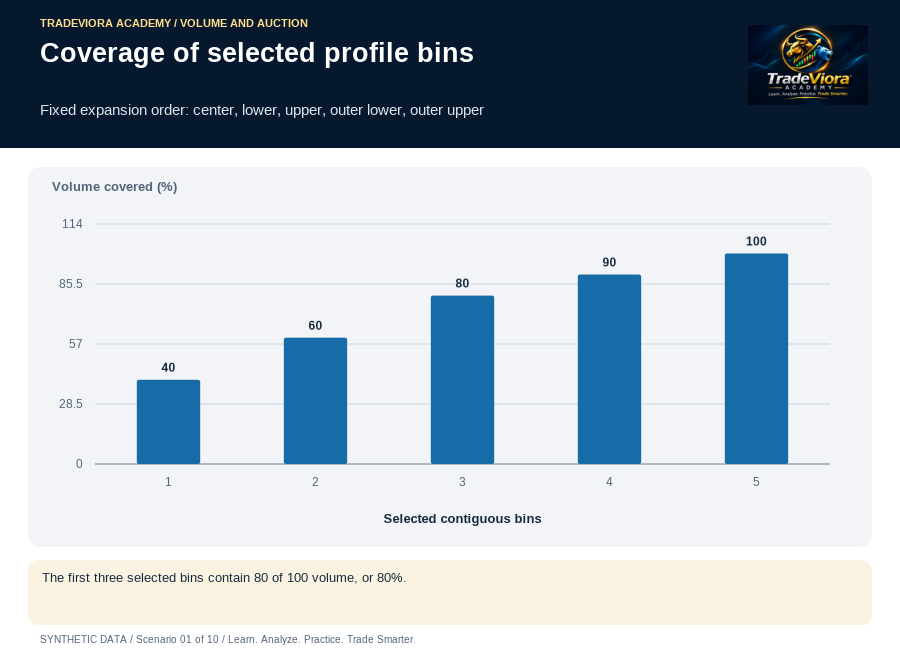
This separate synthetic case illustrates the arithmetic behind the topic. Its invented inputs are independent of the worked example above.
Download this concept’s cheat sheet · Explore scenario illustrations