
FREE FINANCIAL EDUCATION
Point of control (VPOC)
Find a volume point of control under a declared tie-breaking rule.
What you will learn
Prerequisites: Volume-at-price bins, session selection and maximum versus mean.
- Find a volume point of control under a declared tie-breaking rule.
- Distinguish the modal price bin from VWAP.
- Track when a developing VPOC becomes available.
Mechanism and decision rules
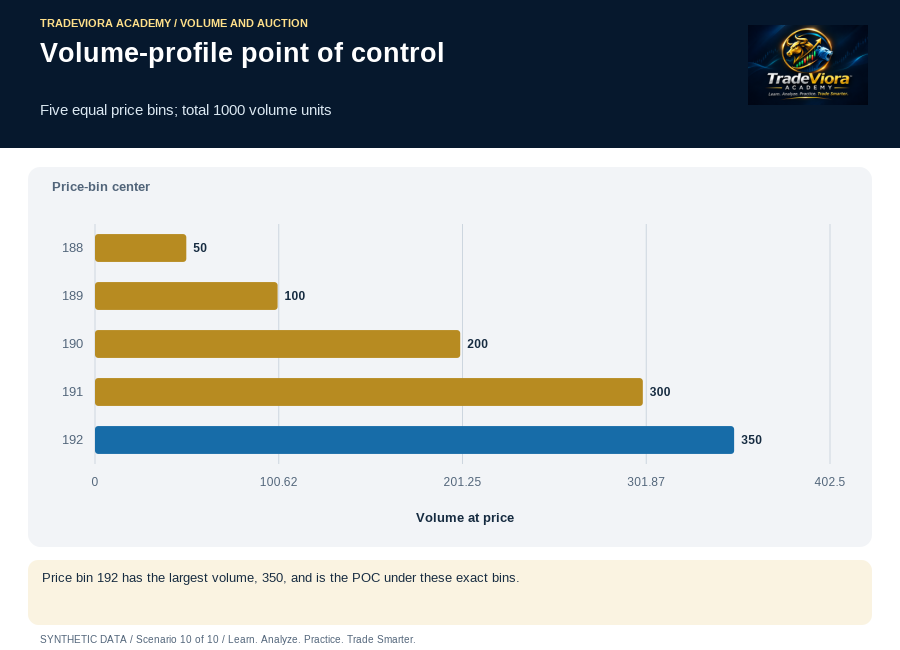
The volume point of control is the price row with the greatest executed quantity in the selected profile. It is a mode of a binned distribution, not a mean price. If multiple rows tie, the platform needs a deterministic rule; document that rule so the result can be reproduced. Changing row width or session boundaries can change the selected row.
A developing VPOC is computed from trades available so far. The final session VPOC incorporates later activity and cannot be used as an earlier signal without look-ahead. A shift in the leading row indicates that accumulated volume rankings changed. It does not by itself prove that new information created fair value or that price must return to that row.
Worked example · synthetic data
Synthetic rows are ₹100: 30 units, ₹101: 70 units and ₹102: 50 units. VPOC is ₹101. VWAP is (100 × 30 + 101 × 70 + 102 × 50)/150 = ₹101.1333, so mode and weighted mean differ.
Later, another 40 units trade at ₹102. That row now contains 90 units and becomes VPOC, while the earlier decision-time VPOC remains ₹101 in the historical record. A backtest that plots the final ₹102 row across the entire session retroactively changes the available information.
Failure modes and limits
VPOC is sensitive to binning, especially in flat or multimodal distributions. A small quantity difference can select one row over another, so inspect neighboring volume rather than treating a one-tick level as exact. Historical high volume is not proof of current resting support or resistance.
Practice case
Rows 200, 201 and 202 have volumes 60, 20 and 60. The rule chooses the tied row closest to the profile midpoint, then the lower row if distances tie. Which VPOC is selected?
Reveal the worked answer
The midpoint is 201. Both 200 and 202 are one unit away and tie at 60 volume. The secondary lower-row rule selects 200. A platform using another documented tie rule could display 202 without either platform miscounting volume.
Check your understanding
Sources and next steps
The lesson, calculations and synthetic cases are original educational material. References explain underlying contract or chart conventions; none validates the profitability of a trading rule. Actual contract specifications, settlement obligations and charges must be checked before trading.
Explore OHLCV data in the chart lab · Explore volume-at-price and TPO data · Practice library
Related quantitative practice
This separate synthetic case illustrates the arithmetic behind the topic. Its invented inputs are independent of the worked example above.
Download this concept’s cheat sheet · Explore scenario illustrations