
FREE FINANCIAL EDUCATION
Transaction-cost models
Separate explicit fees from spread, slippage and impact assumptions.
What you will learn
Prerequisites: Trade quantity, bid–ask spreads, turnover and net P&L.
- Separate explicit fees from spread, slippage and impact assumptions.
- Calculate net strategy P&L using consistent trade-side accounting.
- Stress cost assumptions without double-counting the spread.
Mechanism and decision rules
Transaction costs include explicit charges and execution shortfall. Brokerage, exchange charges and applicable taxes are explicit components whose current schedules require verification. Spread, slippage and market impact arise from how actual fills differ from a reference price. The categories can overlap if defined carelessly: a fill model already buying at ask and selling at bid has incorporated the quoted spread.
Specify whether each rate applies per side, per round trip, per order, per unit or to turnover. Fixed order fees behave differently from proportional costs when size changes. A cost model should follow partial fills and cancellations consistently. Test sensitivity across plausible assumptions because a strategy with small gross edge can be dominated by modest execution error.
Worked example · synthetic data
A synthetic strategy buys 100 shares at ₹100.10 and sells them at ₹101.90. Gross fill-to-fill P&L is ₹180. Assume an illustrative proportional explicit charge of 0.05% on each side, not a real tax schedule. Buy turnover is ₹10,010 and sell turnover ₹10,190, so combined explicit cost is 0.0005 × ₹20,200 = ₹10.10. Net is ₹169.90 before other costs.
If the fills already reflect crossing the spread, subtracting the same spread again would double-count it. If a midpoint backtest generated the fills instead, spread must be modeled separately. The reference-price definition controls the accounting.
Failure modes and limits
Real Indian charges vary by instrument, transaction and date; never reuse an illustrative rate as current legal guidance. Impact is often nonlinear in size and market conditions. Costs correlated with adverse signals can be worse than a constant average. Excluding unfilled orders can also bias opportunity-cost comparisons.
Practice case
Buy 200 units at ₹50 and sell at ₹51. An illustrative fee is 0.1% of turnover on each side. Compute gross P&L, combined turnover, explicit fees and net P&L.
Reveal the worked answer
Gross P&L is ₹200. Buy turnover is ₹10,000 and sell turnover ₹10,200, totaling ₹20,200. Fees are ₹20.20, leaving ₹179.80 before any additional modeled friction. The rate applies separately to both traded sides through their combined turnover.
Check your understanding
Sources and next steps
The lesson, calculations and synthetic cases are original educational material. References explain underlying contract or chart conventions; none validates the profitability of a trading rule. Actual contract specifications, settlement obligations and charges must be checked before trading.
Explore OHLCV data in the chart lab · Explore volume-at-price and TPO data · Practice library
Related quantitative practice
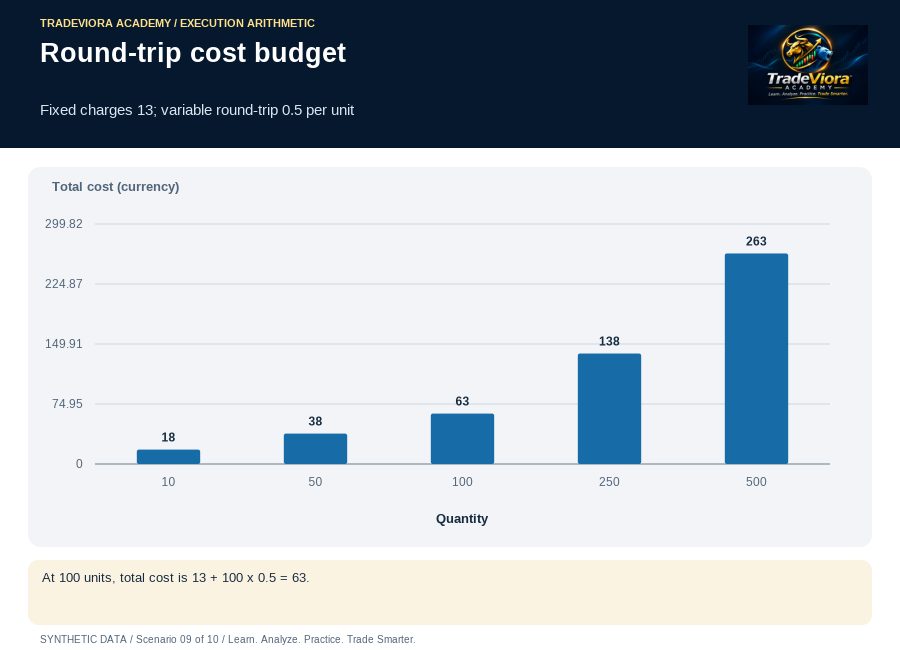
This separate synthetic case illustrates the arithmetic behind the topic. Its invented inputs are independent of the worked example above.
Download this concept’s cheat sheet · Run the related Python example · Explore scenario illustrations