FREE FINANCIAL EDUCATION
Volatility and expiry risk in option packages
Separate terminal payoff bounds from pre-expiry sensitivity and funding paths.
What you will learn
Prerequisites: Greeks, multi-leg payoffs and contract settlement.
- Separate terminal payoff bounds from pre-expiry sensitivity and funding paths.
- Apply distinct volatility shocks across expiries or strikes.
- Identify expiry mismatches that invalidate a simple defined-risk label.
Mechanism and decision rules
A strategy diagram summarizes a specified expiry payoff under matching assumptions. Before expiry, a package can respond to underlying movement, volatility changes, time passage and liquidity. Net Greeks provide local summaries, but a single parallel volatility shock can hide skew and term-structure exposure. A package with near-zero summed vega may still lose if the sold expiry’s IV rises while the bought expiry’s IV falls.
Expiry introduces a second kind of risk: the position can change form as individual legs settle, are assigned or are closed. A protective option that expires first cannot bound a later short option’s loss. Check underlying, units, strikes, expiries and settlement form leg by leg. The label on a strategy builder is not a substitute for its actual contract inventory.
Worked example · synthetic data
A synthetic two-expiry package has +₹100 vega per volatility point in its far long leg and −₹100 in its near short leg. A parallel one-point increase approximately nets to zero. But if near IV rises three points while far IV is unchanged, the local volatility contribution is −₹300.
Separately, a short call expiring next month paired with a protective long call expiring this week is not protected after this week’s long disappears. A same-expiry vertical-spread maximum-loss formula cannot be applied to the subsequent uncovered period.
Failure modes and limits
Greek approximations are local and can fail for large jumps. Settlement prices, liquidity and margin requirements can change sharply near expiry. American exercise and stock delivery rules require product-specific handling. Model a sequence of positions and cash obligations through time rather than only one attractive final diagram.
Practice case
A package has +₹60 vega per point in one expiry and −₹40 in another. The long expiry’s IV falls two points and the short expiry’s IV rises one point. Calculate the local volatility P&L contribution.
Reveal the worked answer
The long-vega leg contributes 60 × (−2) = −₹120. The short-vega leg contributes −40 × 1 = −₹40. Total is −₹160. Applying a single net-vega number of +20 to an arbitrary average shock would conceal the distinct movements.
Check your understanding
Sources and next steps
The lesson, calculations and synthetic cases are original educational material. References explain underlying contract or chart conventions; none validates the profitability of a trading rule. Actual contract specifications, settlement obligations and charges must be checked before trading.
Explore OHLCV data in the chart lab · Explore volume-at-price and TPO data · Practice library
Related quantitative practice
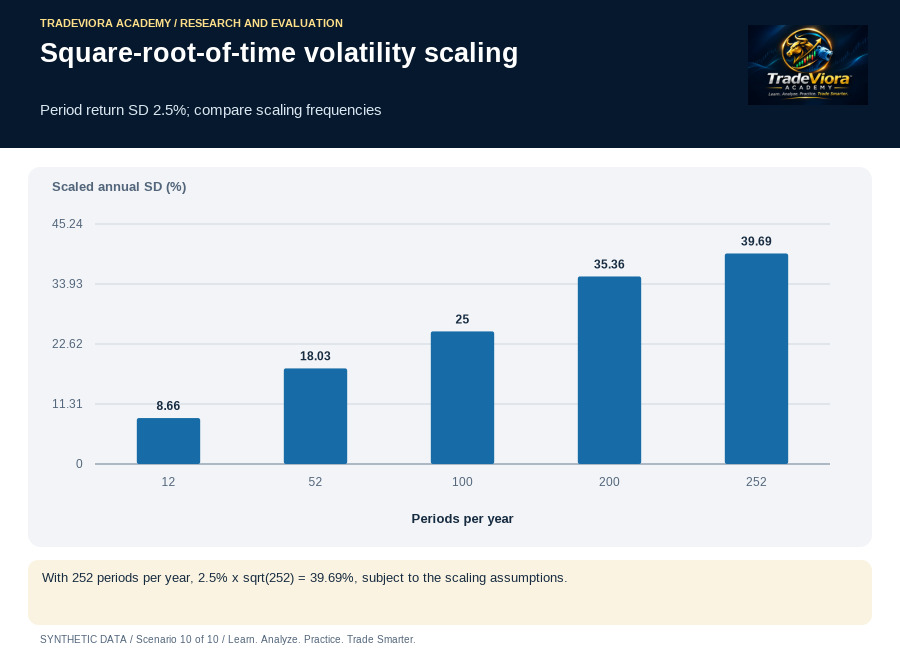
This separate synthetic case illustrates the arithmetic behind the topic. Its invented inputs are independent of the worked example above.
Download this concept’s cheat sheet · Run the related Python example · Explore scenario illustrations
Apply the measurement to genuine historical data
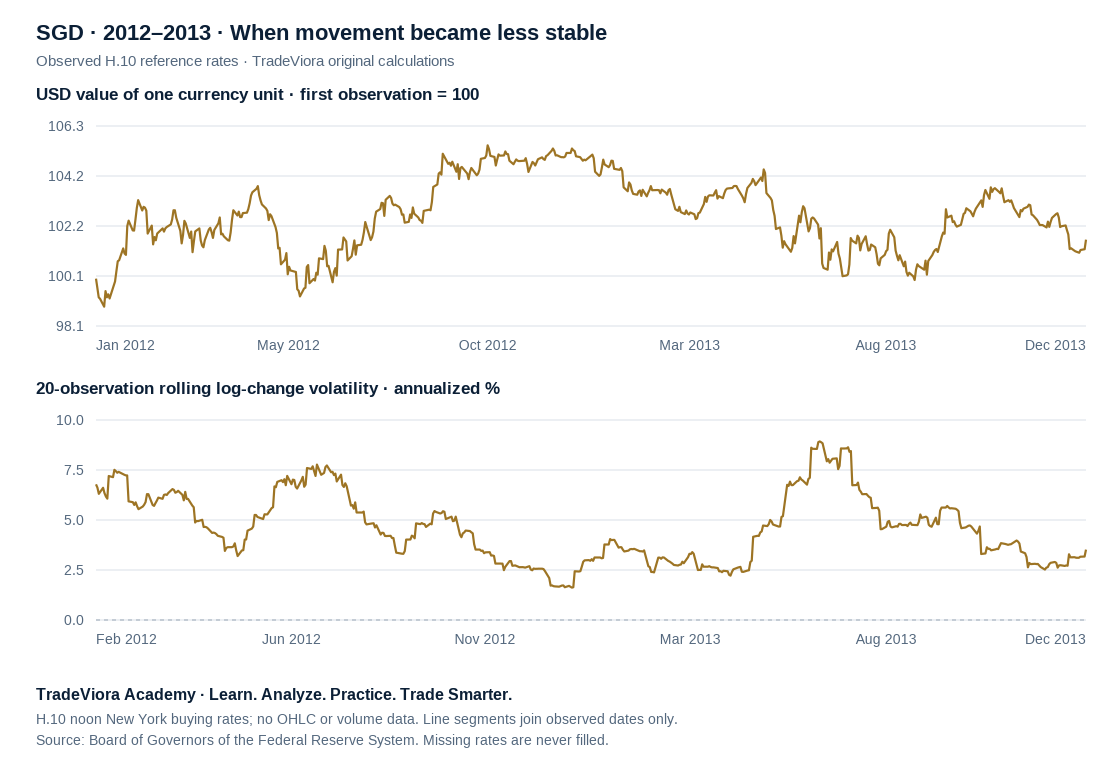
Singapore dollar, 2012–2013: when movement became less stable uses Federal Reserve H.10 reference-rate observations. It is an FX measurement exercise, not a test of a trading strategy or an OHLC candlestick record.