
FREE FINANCIAL EDUCATION
Long straddle
Combine an at-one-strike long call and long put into an absolute-move payoff.
What you will learn
Prerequisites: Call and put expiry payoffs, premium and same-expiry series.
- Combine an at-one-strike long call and long put into an absolute-move payoff.
- Calculate both expiry breakevens and maximum premium loss.
- Explain why a large realized move can still be insufficient after expensive entry.
Mechanism and decision rules
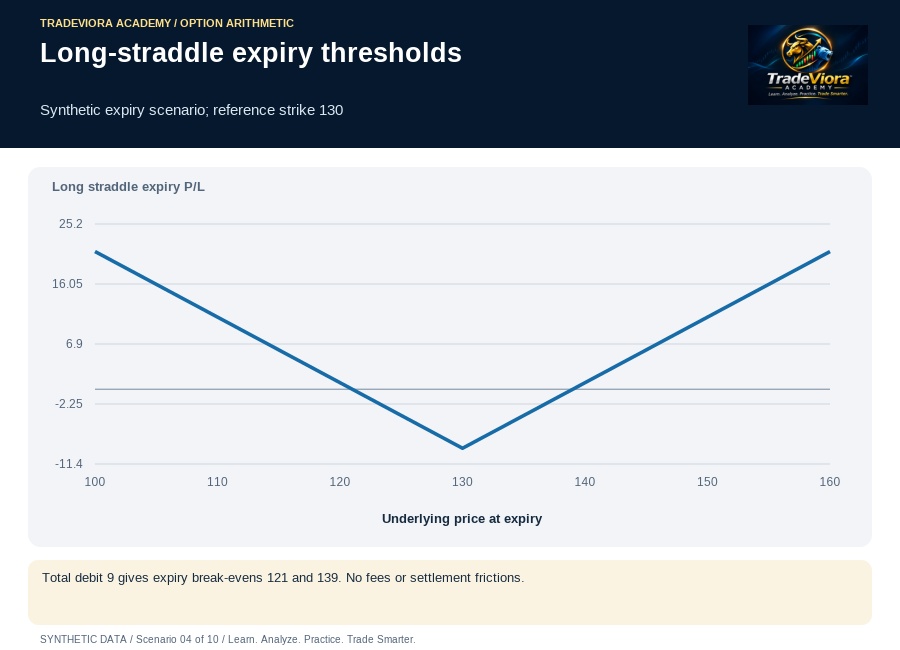
A long straddle buys a call and put at the same strike K and expiry with matching units. At expiry, combined intrinsic payoff is |S − K|. Subtract total premium D to obtain profit. The strategy pays for movement in either direction, but direction independence does not remove the need for a sufficiently large move or a favorable pre-expiry repricing.
The expiry breakevens are K − D and K + D. Maximum standalone premium loss occurs at S = K, where both options have zero intrinsic value. A straddle is often positive gamma and vega and negative theta under common conditions, but these sensitivities change. A known event can make both premiums expensive; “a big move is coming” is not enough if the price of optionality already exceeds the realized opportunity.
Worked example · synthetic data
Buy a synthetic strike-100 call for ₹6 and put for ₹5. Total debit is ₹11. At expiry S = ₹120, call intrinsic is ₹20 and put intrinsic zero, producing ₹9 profit. At S = ₹92, put intrinsic is ₹8, leaving −₹3 despite an eight-point move. At S = ₹100, the full ₹11 is lost.
Breakevens are ₹89 and ₹111. For 50 fictional units, premium outlay is ₹550. Before expiry, the package can gain or lose at prices inside those boundaries because residual time value and IV still matter.
Failure modes and limits
The expiry payoff does not describe every earlier mark. Implied-volatility compression after an event can offset a favorable underlying move. Wide spreads on two legs raise entry and exit costs. Physical settlement and contract mismatch can create operational obligations beyond the simplified cash payoff.
Practice case
A strike-250 call costs ₹14 and the matching put costs ₹11. Find total debit, expiry breakevens and P&L at settlement ₹280 and ₹240.
Reveal the worked answer
Total debit is ₹25, with breakevens ₹225 and ₹275. At ₹280, intrinsic payoff is ₹30 and profit ₹5. At ₹240, payoff is ₹10 and profit −₹15. The two-sided opportunity still requires enough absolute movement to recover both premiums.
Check your understanding
Sources and next steps
The lesson, calculations and synthetic cases are original educational material. References explain underlying contract or chart conventions; none validates the profitability of a trading rule. Actual contract specifications, settlement obligations and charges must be checked before trading.
Explore OHLCV data in the chart lab · Explore volume-at-price and TPO data · Practice library
Related quantitative practice
This separate synthetic case illustrates the arithmetic behind the topic. Its invented inputs are independent of the worked example above.
Download this concept’s cheat sheet · Explore scenario illustrations