
FREE FINANCIAL EDUCATION
Daily loss limits
Define the components and reset boundary of a daily loss limit.
What you will learn
Prerequisites: Realized and unrealized P&L, order state and account risk budgets.
- Define the components and reset boundary of a daily loss limit.
- Calculate remaining capacity with open risk and realized losses.
- Specify a stop-trading state that survives restarts and pending orders.
Mechanism and decision rules
A daily loss limit is a governance rule about when the strategy stops taking additional risk and how existing exposure is handled. Define whether it uses realized P&L, marked equity, fees, open stop-risk or some combination. Also define the session boundary and reset conditions. A limit that resets whenever software restarts is not a durable daily control.
The threshold does not guarantee the account cannot lose more. The rule must specify the response: block new entries, cancel pending entries, reduce or close current positions, and reconcile execution. An account-wide limit must aggregate strategies and symbols; otherwise multiple components can each consume the same budget. A review or cooldown after breach should not automatically authorize a larger recovery trade.
Worked example · synthetic data
A synthetic account sets a ₹3,000 daily planned-loss budget. Realized losses including fees are ₹1,200, and remaining downside to the declared exits of open trades is ₹1,100. Available planned capacity is ₹700. A new candidate requesting ₹900 fails even though realized losses alone remain below the daily cap.
Later a gap causes an open trade to lose ₹1,600 instead of the reserved ₹1,100. The cap has not prevented the extra ₹500; it is a decision rule under uncertain execution, not insurance. The system must update from actual fills and enforce its stop-trading response.
Failure modes and limits
Unrealized P&L can fluctuate around a threshold, so repeated enable/disable behavior needs a clear latch rule. Different strategies may share correlated exposure. Broker marks and local marks can differ. Include charges consistently and preserve the breached state through reconnects until the authorized reset condition.
Practice case
Daily limit is ₹2,500. Realized losses are ₹900, fees not yet included are ₹100 and open planned risk is ₹1,000. What capacity remains if the rule includes all three?
Reveal the worked answer
Remaining capacity is 2,500 − 900 − 100 − 1,000 = ₹500. If a new order requires more, it is blocked or reduced under the rule. Fees must not be counted twice if already included in the realized P&L field.
Check your understanding
Sources and next steps
The lesson, calculations and synthetic cases are original educational material. References explain underlying contract or chart conventions; none validates the profitability of a trading rule. Actual contract specifications, settlement obligations and charges must be checked before trading.
Explore OHLCV data in the chart lab · Explore volume-at-price and TPO data · Practice library
Related quantitative practice
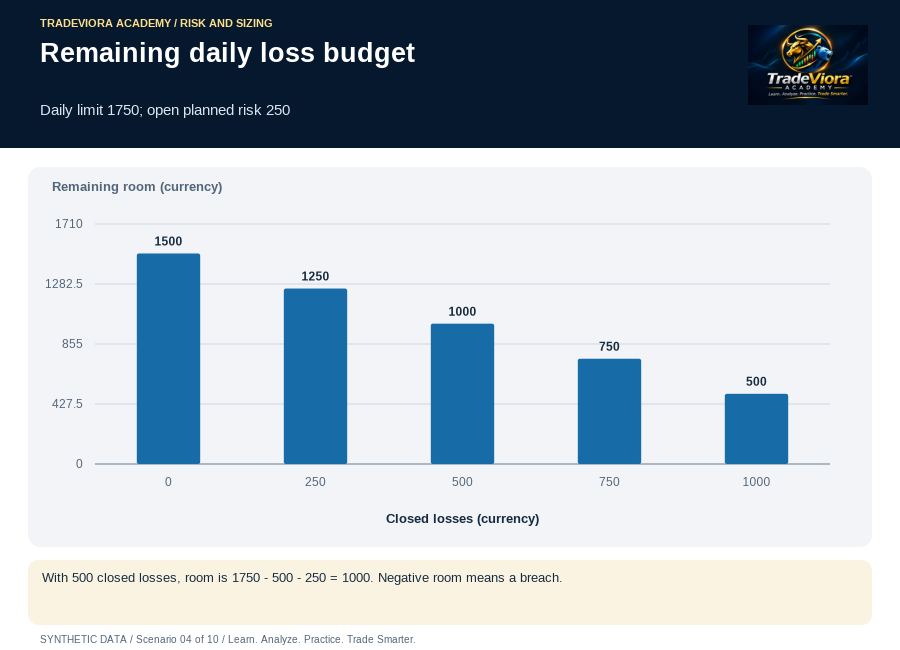
This separate synthetic case illustrates the arithmetic behind the topic. Its invented inputs are independent of the worked example above.
Download this concept’s cheat sheet · Explore scenario illustrations