
FREE FINANCIAL EDUCATION
Node retests and executable invalidation
Turn a historical node retest into a complete observable trade specification.
What you will learn
Prerequisites: Volume nodes, entry triggers and stop-distance sizing.
- Turn a historical node retest into a complete observable trade specification.
- Separate a reference zone from an executable entry price.
- Calculate how a wide node and delayed fill alter risk.
Mechanism and decision rules
A node retest occurs when price returns to a previously identified volume region. The node is context, not an order. Define its boundaries, the required response, the earliest eligible entry and invalidation. A rule might require a completed close back above the node’s upper edge after a probe, while another might use a passive limit inside the region. Those choices have different fill and selection risks.
Use a zone consistent with bin resolution rather than pretending a broad node is one exact price. Place invalidation according to the hypothesis, then size from the actual entry assumption. If the node is so wide that the trade cannot fit risk or reward constraints, rejecting it is a valid outcome. Do not narrow the zone after the fact to make a successful example look precise.
Worked example · synthetic data
A synthetic prior node spans ₹100–₹102. A long-retest rule requires price to probe the zone and later close above ₹102. The modeled fill is ₹102.50, invalidation ₹99.50 and target ₹108.50. Price risk is ₹3 and reward ₹6, giving 2:1 before costs.
If the first executable fill is ₹105, unchanged invalidation and target produce ₹5.50 risk and ₹3.50 reward, about 0.64:1. The historical node has not changed, but the actionable opportunity has. A maximum entry price can enforce the intended payoff constraints.
Failure modes and limits
A retest can pass through the entire node without reversing. Historical volume does not guarantee current depth. A close-based confirmation is only available after the bar completes. Intrabar stop/target ordering may be unknown in coarse data, and narrow limits can cause missed fills.
Practice case
A node spans 200–204. Entry is 205, invalidation 199 and target 217. With risk budget ₹1,400 and ₹1 per-unit friction reserve, calculate quantity and gross ratio.
Reveal the worked answer
Price risk is ₹6 and budgeted unit risk ₹7, allowing 200 units. Gross reward is ₹12, so ratio is 2:1. The calculation is conditional on the entry and exit assumptions; a gap can exceed the reserved loss.
Check your understanding
Sources and next steps
The lesson, calculations and synthetic cases are original educational material. References explain underlying contract or chart conventions; none validates the profitability of a trading rule. Actual contract specifications, settlement obligations and charges must be checked before trading.
Explore OHLCV data in the chart lab · Explore volume-at-price and TPO data · Practice library
Related quantitative practice
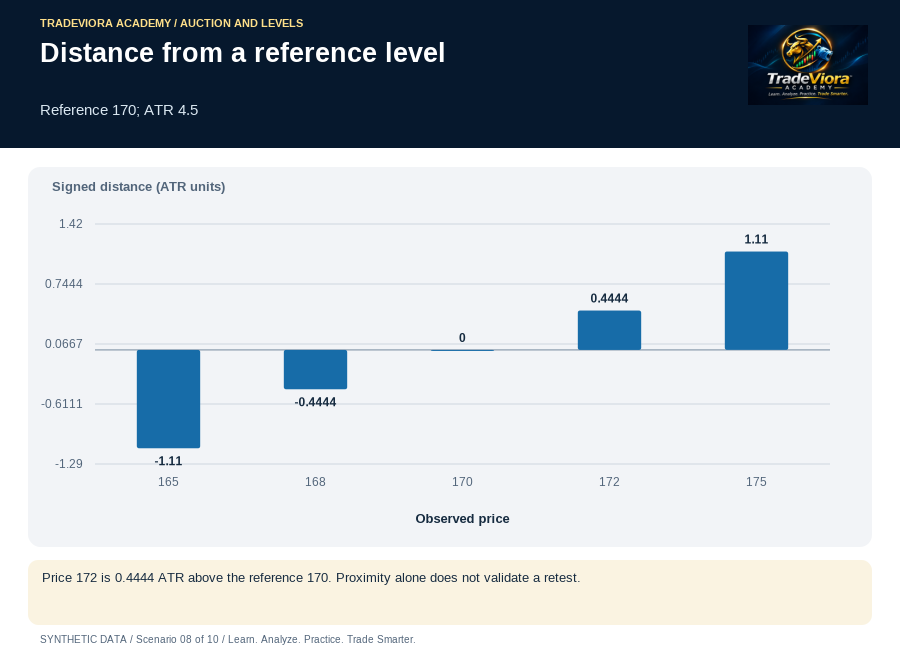
This separate synthetic case illustrates the arithmetic behind the topic. Its invented inputs are independent of the worked example above.
Download this concept’s cheat sheet · Explore scenario illustrations