
1. What is ATRP's formula here?
- ATR multiplied by outstanding shares
- Close divided by volume
- 100 times ATR divided by close
Reveal answer and explanation
C. Normalisation converts price-unit ATR into a relative percentage measure.
FREE FINANCIAL EDUCATION
Study average true range percent and scale comparisons through mechanisms, a synthetic worked case, practice, and explained assessment.
APPLIED STUDY · ORIGINAL LESSON
Before you begin: Complete ATR, position quantity and percentage-return lessons.
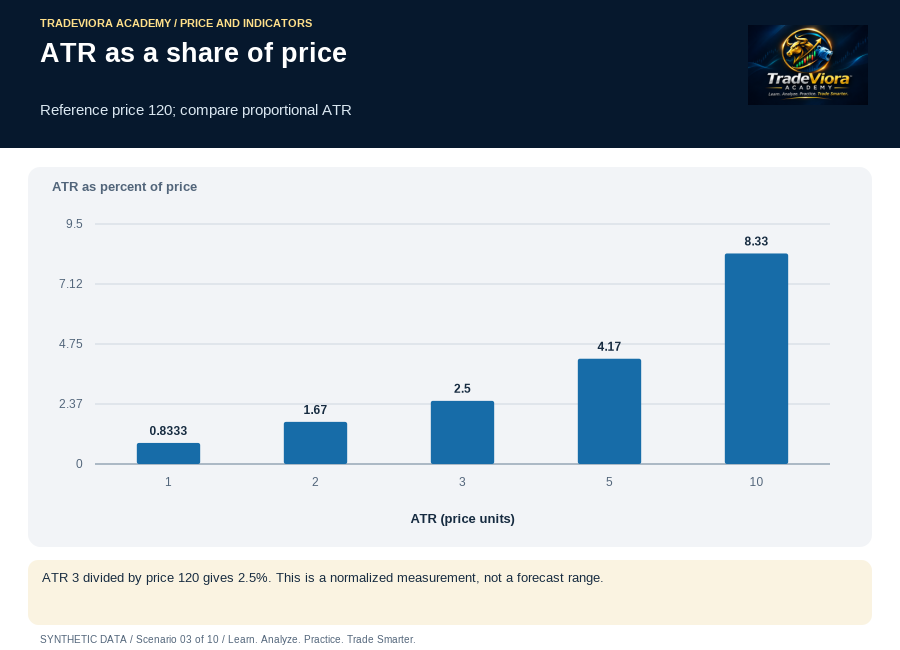
ATRP expresses ATR relative to a selected price, commonly the current close:100×ATR/close. Raw ATR has price units, so a ten-point range on a 500-unit asset can be proportionally smaller than a two-point range on a 50-unit asset. ATRP makes that scale difference explicit. It is still a range-based historical measure, not the standard deviation of returns and not a probability of the next day's loss.
Comparisons require matched construction. Use the same bar duration, ATR smoothing and lookback, and compatible session coverage. A daily ATRP from one instrument should not be ranked against an hourly ATRP from another as though they measured equal horizons. The denominator also matters: if price falls while ATR stays constant, ATRP rises mechanically. A ratio increase can therefore combine greater absolute movement with a lower price base, or arise from the denominator alone.
Synthetic asset A closes 50 with ATR 2, giving ATRP 4%. Asset B closes 500 with ATR 10, giving 2%. B's absolute ATR is five times larger, but A's relative range is twice as large. An equal₹10,000 allocation buys 200 units of A or 20 of B before costs. A one-ATR price move corresponds to₹400 for A and₹200 for B. Equal cash allocation therefore does not imply equal range-scaled exposure.
If the planned distance is one ATR and the nominal distance budget is₹450, quantities before lot and capital constraints would be 450/2=225 units of A and 450/10=45 of B. Their purchase values would be₹11,250 and₹22,500. Equalising this one distance measure changes capital requirements and does not equalise gap, liquidity or company risk. If A's close falls to 40 while ATR remains 2, ATRP becomes 5% without any change in the ATR numerator.
ATRP becomes unstable when the denominator approaches zero and may be inappropriate for instruments with nonpositive prices. Splits require consistent adjustment of both price and ATR history. A current high ATRP can reflect a recent shock whose future persistence is uncertain. Do not interpret a chosen ATR multiple as a guaranteed loss cap.
Asset C closes 80 with ATR 1.6; asset D closes 200 with ATR 6. Calculate ATRP for each and the one-ATR movement of an equal₹8,000 allocation.
C has 2% ATRP and 100 units, giving₹160 for one ATR. D has 3% ATRP and 40 units, giving₹240. Under these simplified equal-cash assumptions D has the larger range-scaled exposure, despite fewer units. Costs, execution and lot constraints are outside this arithmetic example.
Choose an answer before opening each explanation. These questions test the specific mechanism in this lesson.
C. Normalisation converts price-unit ATR into a relative percentage measure.
A. A ratio changes when either numerator or denominator changes.
B. The relative range of each instrument determines the movement for equal invested cash.
Original explanation and synthetic calculations. Chart thresholds are explicit research conventions, not exchange rules or proof of predictive ability.
This separate synthetic case illustrates the arithmetic behind the topic. Its invented inputs are independent of the worked example above.
Download this concept’s cheat sheet · Run the related Python example · Explore scenario illustrations