
FREE FINANCIAL EDUCATION
Breakout retests and entry timing
Define a retest band and a completed-bar confirmation rule.
What you will learn
Prerequisites: Frozen price levels, completed closes and next-opportunity execution.
- Define a retest band and a completed-bar confirmation rule.
- Prevent a later confirmation from being used to justify an earlier fill.
Mechanism and decision rules
A retest rule waits for price to revisit a former boundary after a breakout. Without a precise band and ordering rule, almost any later oscillation can be described as a retest. Freeze the boundary using data available before the breakout, define how near price must return, and specify the maximum allowed delay. The retest is an observed sequence, not a hidden intention attributed to market participants.
This illustrative long rule first requires a completed close above the boundary. Within the next three sessions, a later session must trade into a specified band around the boundary and close above the boundary. The hypothetical entry occurs at the next stated executable price after that confirming session. A touch within the band during the day does not establish its eventual close in advance.
Separate signal availability from fill assumptions. If confirmation depends on the closing price, a backtest cannot buy at that same day’s earlier low because the low later looked attractive. A conditional intraday order could be a different strategy, but its rules and available information must be declared separately. Retests that never occur should remain recorded as unfilled opportunities rather than disappearing from the comparison.
Worked example · synthetic data
The frozen boundary is 100, and the retest band is [99.5, 100.5]. A first session closes at 102. The next session has a low of 100.2 and closes at 101, meeting both the band and closing conditions. The following stated entry is 101.5 with a planned stop at 99, giving 2.5 risk per share. A 500 price-risk allowance permits 200 shares before other limits. Filling at the confirming session’s 100.2 low would use a price that occurred before the close-based confirmation was known.
Failure modes and limits
Daily OHLC can show that a level was visited but not every intraday sequence or executable quote. A very wide band changes the definition of a retest and the sample composition. Gaps can skip the intended next entry or stop. Test the rule using the actual observation resolution and retain a policy for missing data, rather than silently assuming the most favorable path.
Practice case
A boundary is 200 and the retest band [199, 201]. In the second session after a completed breakout, the low is 200.5 and close 202. The next executable entry is 203 and stop 198, with a 1,000 planned-risk allowance. Does the retest qualify, what is the quantity, and can the close-confirmed rule claim a fill at 200.5? State the timing reason.
Reveal the worked answer
The low lies inside the band and the close is above 200, so the retest qualifies under the stated sequence. Risk is 203 − 198 = 5 per share, permitting 200 shares before costs and other constraints. The rule cannot claim the earlier 200.5 low as its confirmed entry because the required close had not yet occurred. A different intraday entry policy would need separate testing and its own risk assumptions.
Check your understanding
Sources and next steps
The lesson, calculations and synthetic cases are original educational material. References explain underlying contract or chart conventions; none validates the profitability of a trading rule. Actual contract specifications, settlement obligations and charges must be checked before trading.
- www.investor.gov: reference documentation
- www.tradingview.com: reference documentation
- www.cmegroup.com: reference documentation
Explore OHLCV data in the chart lab · Explore volume-at-price and TPO data · Practice library
Related quantitative practice
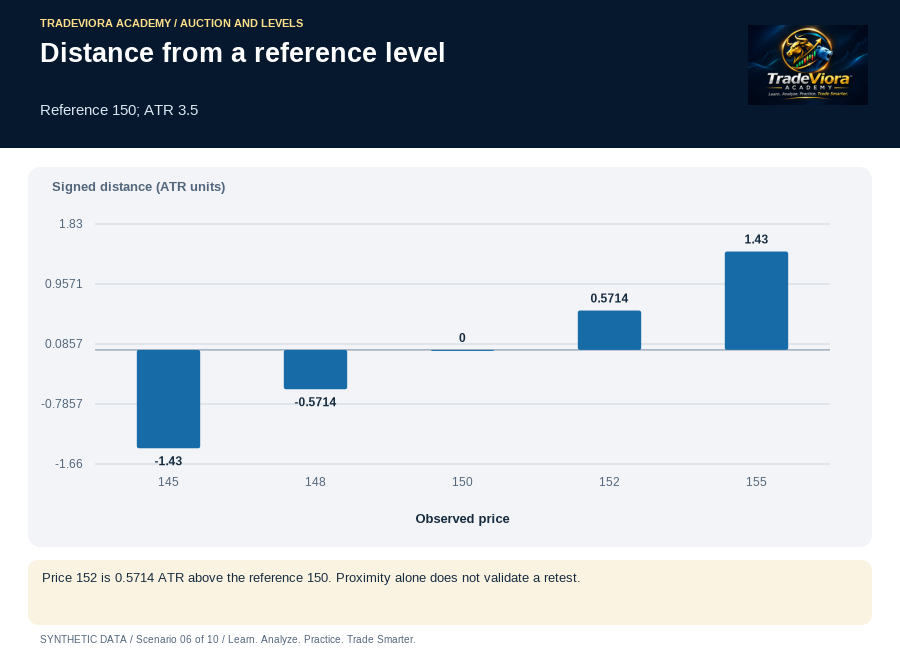
This separate synthetic case illustrates the arithmetic behind the topic. Its invented inputs are independent of the worked example above.
Download this concept’s cheat sheet · Explore scenario illustrations