
1. What is the main-case zone width versus risk distance?
- Both 4
- Both 6
- Width 4 and distance 6
Reveal answer and explanation
C. Entry 105 and stop 99 include more than the 100–104 zone width.
FREE FINANCIAL EDUCATION
Study zone width and position size through mechanisms, a synthetic worked case, practice, and explained assessment.
APPLIED STUDY · ORIGINAL LESSON
Before you begin: Know near/far zone edges, contract point value and planned stop prices.
Zone width is not automatically the trade's risk distance. Risk depends on entry location, stop reference, buffer, point value and costs. For a long entered above a demand zone, entry-to-stop distance includes the space to the near edge, the zone width and any buffer below the far edge. A confirmation entry farther away can increase risk without changing the zone itself.
Under a simplified exact-stop model, per-unit monetary risk equals price distance times point value plus the stated per-unit round-trip cost allowance. Divide the nominal risk budget by that amount and round down to a valid lot increment. The result is planned exposure, not a guarantee of maximum realized loss. Gap execution and variable costs can exceed the allowance.
Keep zone width, entry distance, buffer and quantity as separate fields. Otherwise a wider zone may appear to produce more currency profit simply because the study used a different risk amount. Comparing outcomes in initial-risk units can help, but it does not remove liquidity constraints or make a tiny stop economically executable.
Synthetic demand spans 100–104. A long entry 105 uses stop 99, a1-point buffer below the far edge. Zone width 4, but risk distance 6. With point value 10 and per-unit costs 2, planned risk per unit is 62. A620 budget permits 10 units. Using width 4 alone would imply 40 before costs and overstate the permissible quantity.
If the entry instead occurs at 107 with the same stop, per-unit risk becomes 82 and whole-unit size falls to 7, using 574 of the budget. The unused 46 arises from indivisible units, not a calculation error. The later entry's different reward distance must also be evaluated.
Contract multipliers, minimum lots and account currency conversions must match the instrument. A stop below a zone is a chosen invalidation policy, not a protected fill price. Fees may include fixed amounts that do not scale per unit. Illiquid instruments can make even the rounded quantity too large for realistic execution.
Demand 200–205, entry 206, stop 198, point value 5, per-unit cost allowance 1, risk budget 500 and minimum lot increment 2. Calculate zone width, risk distance, per-unit risk, valid quantity and nominal total risk. State how a gap through 198 affects the budget interpretation.
Width 5, risk distance 8, per-unit risk 8×5+1=41. Raw size 500/41≈12.195; rounding down to a multiple of 2 gives 12. Nominal total risk 492, leaving 8. A gap fill below 198 increases realized loss beyond this exact-stop scenario; the budget is a planning assumption rather than a contractual cap on loss.
Choose an answer before opening each explanation. These questions test the specific mechanism in this lesson.
C. Entry 105 and stop 99 include more than the 100–104 zone width.
A. Twelve is the largest multiple of 2 whose 41-per-unit nominal risk fits 500.
B. Separating components makes sizing and strategy assumptions reviewable.
Original explanation and synthetic calculations. Chart thresholds are explicit research conventions, not exchange rules or proof of predictive ability.
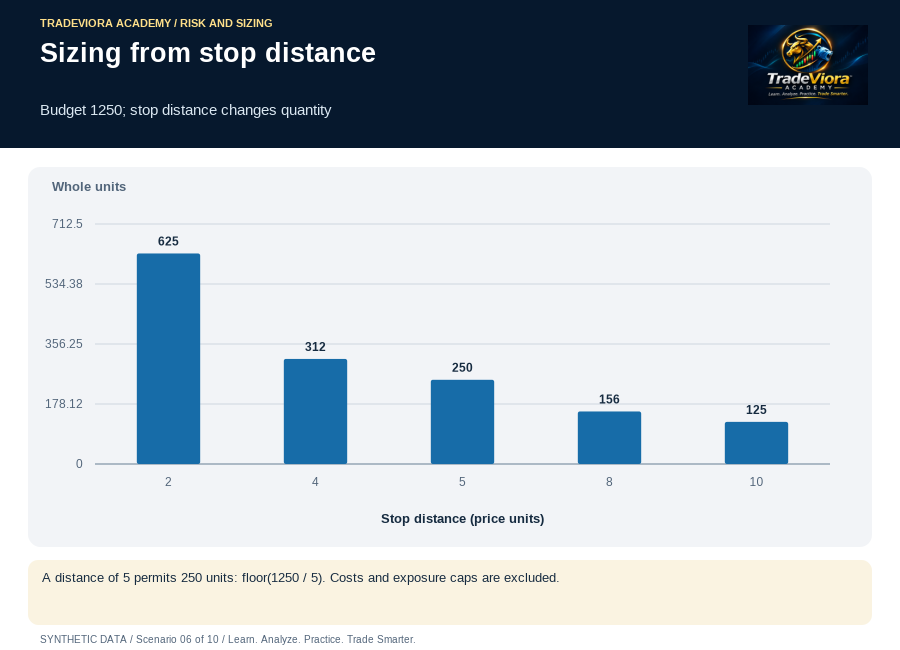
This separate synthetic case illustrates the arithmetic behind the topic. Its invented inputs are independent of the worked example above.
Download this concept’s cheat sheet · Try the related calculator · Run the related Python example · Explore scenario illustrations