Learning objectives
- Calculate gross and net security exposure relative to net asset value.
- Show why a small net position can retain substantial loss and funding risk.
Prerequisites: Understand long and short position profit and a basic balance sheet.
Mechanism and interpretation
For the linear positions in this lesson, gross security exposure equals long market value plus the absolute value of shorts, divided by portfolio net asset value. Net security exposure subtracts short value from long value before dividing by NAV. Cash is excluded from these exposure numerators but included in NAV. Report the denominator and instrument treatment explicitly, because derivative notional, delta-adjusted exposure and accounting asset value are different measurements.
Gross exposure describes the scale of positions that can generate gains, losses and financing needs. Net exposure summarizes a signed imbalance, but it cancels opposing amounts even when the underlying assets have different risks. A long-short pair with zero net exposure can lose on both sides if the long falls while the shorted asset rises. Borrow costs, margin requirements, collateral restrictions and short recalls are additional channels not captured by the two ratios.
Worked case · synthetic data
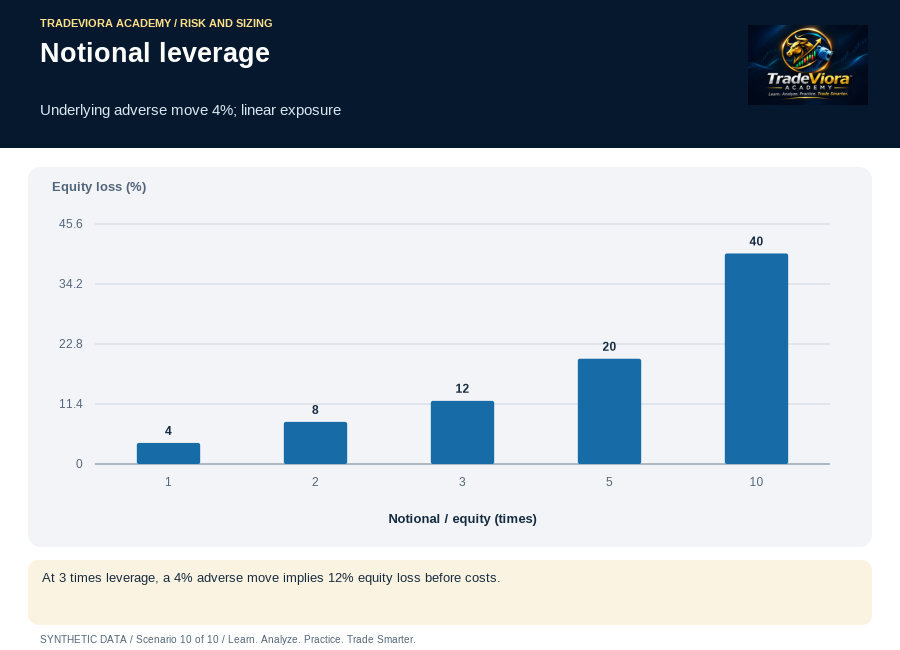
A hypothetical portfolio has NAV 100, long securities worth 150 and short liabilities worth 50, with zero remaining cash under the simplified balance sheet. Gross exposure is (150+50)/100=200%; net exposure is (150−50)/100=100%. If the long side falls 10% and the shorted assets rise 20%, losses are 15 and 10. Ending NAV is 75, a 25% loss before costs. Net exposure of 100% did not mean the portfolio behaved like a single unleveraged asset.
Failure modes and context
The initial denominator changes after gains or losses, so exposure ratios can rise without new trades. Shorts can face losses exceeding their original sale proceeds, and short-sale cash may be restricted rather than freely spendable. Net market value also differs from net beta or factor exposure. For options or other nonlinear instruments, a simple notional sum can conceal sensitivity changes; the linear examples here do not establish an all-purpose leverage measure.
Practice assignment
A separate account has NAV 100, long positions of 80, shorts of 80 and accounting cash of 100. Compute initial gross and net exposure. Then assume longs fall 5%, shorted assets rise 5% and cash earns zero. Calculate loss and ending NAV. Do not assume the reported cash is unrestricted for withdrawal.
Worked answer
Gross exposure is 160%; net exposure is zero. Long losses are 4 and short losses are 4, giving an 8 loss and ending NAV 92. The balance sheet reconciles: cash 100 plus long value 76 minus short liability 84 equals 92. Zero net exposure did not prevent losses, and the example deliberately makes no claim that all cash collateral can be spent.
Check your understanding
Question 1
What is gross exposure with long 150, short 50 and NAV 100?
- 200%
- 100%
- 150%
Reveal answer and reasoning
A. 200%
Gross exposure adds the absolute values before dividing by NAV.
Question 2
Can a zero-net long-short portfolio lose on both sides?
- No
- Only when cash is negative
- Yes
Reveal answer and reasoning
C. Yes
The long asset can fall while the different shorted asset rises.
Question 3
Is accounting short-sale cash necessarily free to withdraw?
- Only if net exposure is zero
- No
- Yes
Reveal answer and reasoning
B. No
Collateral and financing arrangements can restrict its use.