Learning objectives
- Compare signed-volume magnitude with signed-volume proportion.
- Handle unknown volume and zero denominators explicitly.
Prerequisites: Calculate total classified volume and delta.
Mechanism and interpretation
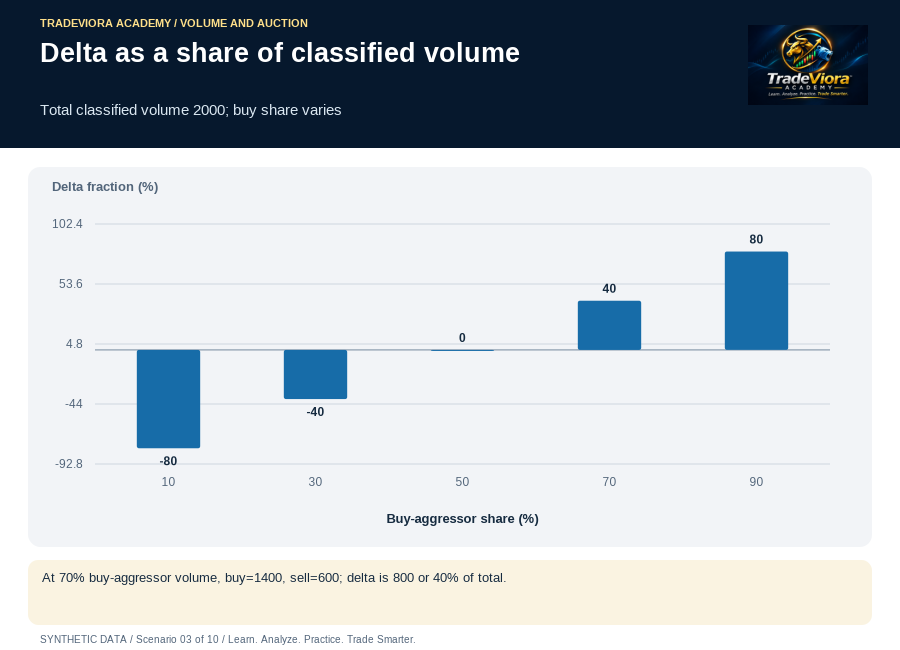
Raw delta measures a quantity difference. Normalized delta divides that difference by a specified volume measure, allowing a comparison of imbalance proportion across activity levels. With only classified buys B and sells S, the ratio(B−S)/(B+S) lies between−1 and 1 when quantities are nonnegative and the denominator is positive. It does not encode the total amount traded.
Publish raw quantity, denominator and ratio together. A small bar can be highly one-sided while contributing little total flow. When unknown-side volume exists, choose whether to normalize by classified or total volume and show coverage. Do not silently substitute zero for an undefined ratio in a zero-volume interval; zero means balanced measured flow, whereas undefined means no valid denominator.
Worked case · synthetic data
Bar A has buys 600 and sells 400:delta 200 and normalized delta 20%. Bar B has buys 90 and sells 10:delta 80 but normalized delta 80%. A has the larger signed quantity; B has the stronger classified proportion. If B also contains 100 unknown units, its classified coverage is 50%, and known delta divided by all volume becomes 40%. The uncertainty cannot be removed by changing the denominator.
Failure modes and context
Normalization does not make different instruments economically equivalent or establish a relationship with price. Tiny denominators create extreme ratios from a few trades. Minimum-volume eligibility rules can reduce this instability but change the selected population. Keep the ratio's sign convention stable across charts and exports.
Practice assignment
Compare a bar with buys 240, sells 160 to one with buys 45, sells 5 and 50 unknown units. Calculate raw delta, classified-normalized delta, all-volume-normalized known delta and coverage for the second. State which bar has the larger raw delta.
Worked answer
First delta=80 and classified ratio 20%. Second delta=40, classified ratio 40/50=80%, all-volume ratio 40/100=40%, coverage 50%. The first has larger raw delta despite a less extreme proportion. The unknown 50 units leave the true signed balance uncertain; no normalization identifies their aggressor side.
Check your understanding
Question 1
What is normalized delta for 90 buys and 10 sells?
- 80%
- 80 units per tick
- 90%
Reveal answer and reasoning
A. 80%
Use(90−10)/(90+10)=0.8; the result is a proportion.
Question 2
Does the larger ratio imply larger signed quantity?
- Yes, always
- Only when both bars are red
- No, denominators can differ
Reveal answer and reasoning
C. No, denominators can differ
An 80% imbalance on 100 units can be smaller in raw terms than 20% on 1000.
Question 3
How should a zero-volume denominator be represented?
- Automatically 100% buy
- Undefined or unavailable
- Automatically zero imbalance
Reveal answer and reasoning
B. Undefined or unavailable
No execution quantity exists from which to estimate the stated ratio.