
FREE FINANCIAL EDUCATION
Put–call parity with explicit assumptions
Derive parity from two portfolios with equal expiry payoffs.
What you will learn
Prerequisites: Call and put expiry payoffs; discounting and cash-flow timing.
- Derive parity from two portfolios with equal expiry payoffs.
- Calculate an implied option price in a zero-rate no-dividend example.
- Explain why an apparent parity violation may not be executable arbitrage.
Mechanism and decision rules
For European calls and puts with the same underlying, strike K and expiry T, a no-dividend spot formulation is C − P = S0 − K × exp(−rT), under standard frictionless financing assumptions. One way to derive it is to compare a call plus cash that grows to K with a put plus one unit of underlying. At expiry, both portfolios are worth max(S, K).
The equality depends on matching exercise and settlement terms and on the correct treatment of distributions and financing. A futures-option formulation uses different carry relationships. American exercise rights generally require additional care. Parity is a consistency relationship, not evidence that either the call or put has a profitable directional forecast.
Worked example · synthetic data
Use a synthetic zero-rate, no-dividend European example with S0 = ₹100 and K = ₹100. Parity reduces to C = P. If the call is ₹7, the put should also be ₹7 under the stated model. At expiry S = ₹120, call plus ₹100 cash is worth 20 + 100 = ₹120; stock plus put is 120 + 0 = ₹120. At S = ₹80, both portfolios are worth ₹100.
If S0 = ₹105, K = ₹100 and the call is ₹9 at zero rates, parity implies put = 9 − 105 + 100 = ₹4.
Failure modes and limits
Displayed midpoints are not executable bid and ask prices. Borrowing costs, short-sale constraints, dividends, stale quotes and taxes can explain or prevent trading an apparent discrepancy. Exact current contract terms matter. Do not combine a call and put from different expiries or compare spot-based parity with a futures underlying without adjusting the model.
Practice case
Under zero rates, no dividends and matched European terms, S0 = ₹200, K = ₹210 and call premium is ₹6. Find the implied put premium and verify equality at expiry S = ₹220.
Reveal the worked answer
From C − P = S0 − K = −10, P = ₹16. At expiry, call plus strike cash is 10 + 210 = ₹220. Stock plus put is 220 + 0 = ₹220. Their equal initial theoretical cost is 6 + 210 = 200 + 16 = ₹216.
Check your understanding
Sources and next steps
The lesson, calculations and synthetic cases are original educational material. References explain underlying contract or chart conventions; none validates the profitability of a trading rule. Actual contract specifications, settlement obligations and charges must be checked before trading.
Explore OHLCV data in the chart lab · Explore volume-at-price and TPO data · Practice library
Related quantitative practice
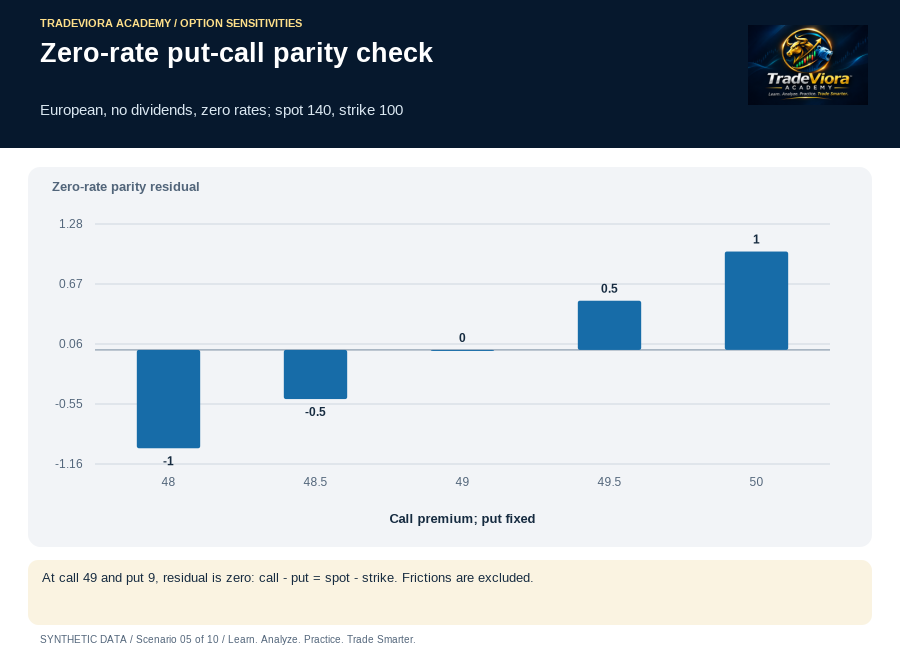
This separate synthetic case illustrates the arithmetic behind the topic. Its invented inputs are independent of the worked example above.
Download this concept’s cheat sheet · Run the related Python example · Explore scenario illustrations