
FREE FINANCIAL EDUCATION
Premium leverage and delta-adjusted exposure
Separate gross underlying notional, premium paid and local delta exposure.
What you will learn
Prerequisites: Delta, option premium, contract quantity and notional exposure.
- Separate gross underlying notional, premium paid and local delta exposure.
- Calculate option-price elasticity without interpreting it as a fixed future return multiplier.
Mechanism and decision rules
An option can reference a large underlying value for a much smaller premium, but several leverage measures answer different questions. Gross underlying notional is spot times units per contract times contract quantity. Premium cash is the option price times those units and quantity. Their ratio measures notional relative to the premium paid; it does not describe the actual sensitivity of an out-of-the-money option.
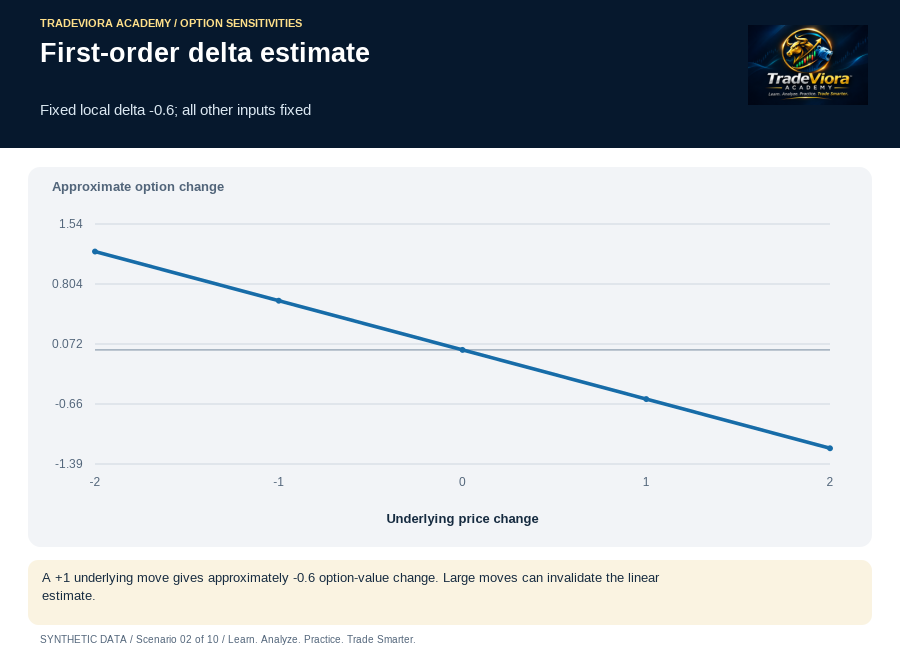
Delta-adjusted exposure multiplies signed contract units by the option delta, producing an approximate underlying-equivalent quantity. Multiplying by spot expresses a local notional exposure. For a long call, local option-price elasticity can be written delta times spot divided by option premium. It estimates the percentage option-price response to a small one-percent underlying move with other inputs fixed.
These are local measures, not constant leverage promises. Gamma changes delta as spot moves, and time and implied volatility affect the option independently. A small premium can make a ratio very large even when the probability or magnitude of an eventual gain is limited. Position risk should therefore include total premium at risk, scenario losses and any exercise-created exposure, rather than relying on a single notional-to-premium multiple.
Worked example · synthetic data
A hypothetical call costs 5 with spot 100 and delta 0.40. Three contracts each cover 100 units. Premium cash is 1,500; gross underlying notional is 30,000, or twenty times the premium. Delta-equivalent quantity is 120 shares and delta-adjusted notional 12,000. Elasticity is 0.40 × 100/5 = 8. A small one-percent spot rise means a one-unit price increase, giving an estimated call rise of 0.40, or 8%, and total position gain of 120 before costs and other effects.
Failure modes and limits
A put’s delta is negative for a long position, so preserve the sign when estimating directional exposure. Short positions reverse it. Ratios using premium become unstable near zero and cannot predict a finite large-move payoff. A fully paid long option can lose its premium, while exercise into an underlying position introduces funding needs and subsequent exposure not captured by the original premium loss limit. Gross notional is useful context, not a substitute for those separate risks.
Practice case
A call has spot 200, premium 8 and delta 0.60. Hold two long contracts of 50 units each. Calculate premium cash, gross notional, notional-to-premium ratio, delta-equivalent quantity, delta-adjusted notional and local elasticity. Estimate the local position gain for a one-percent spot rise. Explain why a repeated series of such moves cannot simply be multiplied by the initial elasticity.
Reveal the worked answer
Premium cash is 800 and gross notional 20,000, giving a ratio of 25. Delta-equivalent quantity is 60 and delta-adjusted notional 12,000. Elasticity is 0.60 × 200/8 = 15. A one-percent spot rise is 2, so the option change is approximately 1.20 and the 100-unit position gains 120, or 15% of premium. After a move the premium and delta change, so the original elasticity does not remain a fixed multiplier.
Check your understanding
Sources and next steps
The lesson, calculations and synthetic cases are original educational material. References explain underlying contract or chart conventions; none validates the profitability of a trading rule. Actual contract specifications, settlement obligations and charges must be checked before trading.
- www.optionseducation.org: reference documentation
- www.theocc.com: reference documentation
- www.ocw.mit.edu: reference documentation
Explore OHLCV data in the chart lab · Explore volume-at-price and TPO data · Practice library
Related quantitative practice
This separate synthetic case illustrates the arithmetic behind the topic. Its invented inputs are independent of the worked example above.
Download this concept’s cheat sheet · Try the related calculator · Explore scenario illustrations