
FREE FINANCIAL EDUCATION
Stress margin and position reduction
Compute incremental collateral under a stressed per-contract requirement.
What you will learn
Prerequisites: Variation settlement, initial collateral and scenario accounting.
- Compute incremental collateral under a stressed per-contract requirement.
- Combine that increase with price losses in a funding budget.
- Evaluate size reduction without pretending it reverses losses already incurred.
Mechanism and decision rules
Posted margin is a current requirement, not an immutable cost of holding a contract. Clearing risk parameters, broker add-ons, concentration and recognized spread offsets can change. A stress-margin exercise asks what happens if the same positions require more eligible support just when their price P&L has reduced available resources.
Start with the amount already posted and calculate the new total requirement for the position that will remain. The increase is the new requirement minus support already allocated, subject to the actual settlement and eligibility rules. Add the separately identified funding needed for price losses without counting the same debit twice. A spreadsheet should show the sequence of transfers and the state of collateral after each event.
Position reduction can lower future margin needs, but closing a contract at the stressed price does not erase its accumulated trading loss. Compare at least two cases: maintaining size with additional funding and reducing to an executable smaller position. The second case must include realistic close-out cost and any loss of offsets on other legs. A lower nominal contract count can sometimes increase a portfolio requirement if it breaks a recognized hedge.
Worked example · synthetic data
Four fictional contracts initially require ₹8,000 each, so ₹32,000 is already posted. The stress requirement becomes ₹15,000 each, or ₹60,000 total. Keeping the position needs ₹28,000 incremental collateral.
At the same time, a 120-point adverse move on ₹50 per point per contract creates a ₹24,000 settlement loss. Under the stated separate-funding convention, additional resources needed are ₹28,000+₹24,000 = ₹52,000. A liquid reserve of ₹60,000 leaves ₹8,000 after funding this scenario. That residual must still cover subsequent moves, fees and any further requirement change; the scenario does not establish a safe maximum size.
Failure modes and limits
Real portfolio margin is not always a linear per-contract sum. Offsets, concentration charges, expiry effects and account-level rules matter. A stressed requirement estimate should be labeled hypothetical rather than presented as a live broker quote. An intended reduction may be unavailable during a halt or may incur substantial slippage, so it should not be the sole source of funding in a severe scenario.
Practice case
Three contracts have ₹10,000 each already posted. New requirements are ₹18,000 per contract. A 100-point adverse move costs ₹20 per point per contract. Compute additional funding if size stays unchanged and compare it with a ₹25,000 reserve.
Reveal the worked answer
New collateral is ₹54,000 versus ₹30,000 posted, requiring ₹24,000 more. Price loss is 100×20×3 = ₹6,000. Additional funding totals ₹30,000, leaving a ₹5,000 shortfall against the reserve. Reducing size may alter the requirement but cannot undo the ₹6,000 loss already accumulated at the stress price.
Check your understanding
Sources and next steps
The lesson, calculations and synthetic cases are original educational material. References explain underlying contract or chart conventions; none validates the profitability of a trading rule. Actual contract specifications, settlement obligations and charges must be checked before trading.
- www.cmegroup.com: reference documentation
- www.nseclearing.in: reference documentation
- www.cmegroup.com: reference documentation
Explore OHLCV data in the chart lab · Explore volume-at-price and TPO data · Practice library
Related quantitative practice
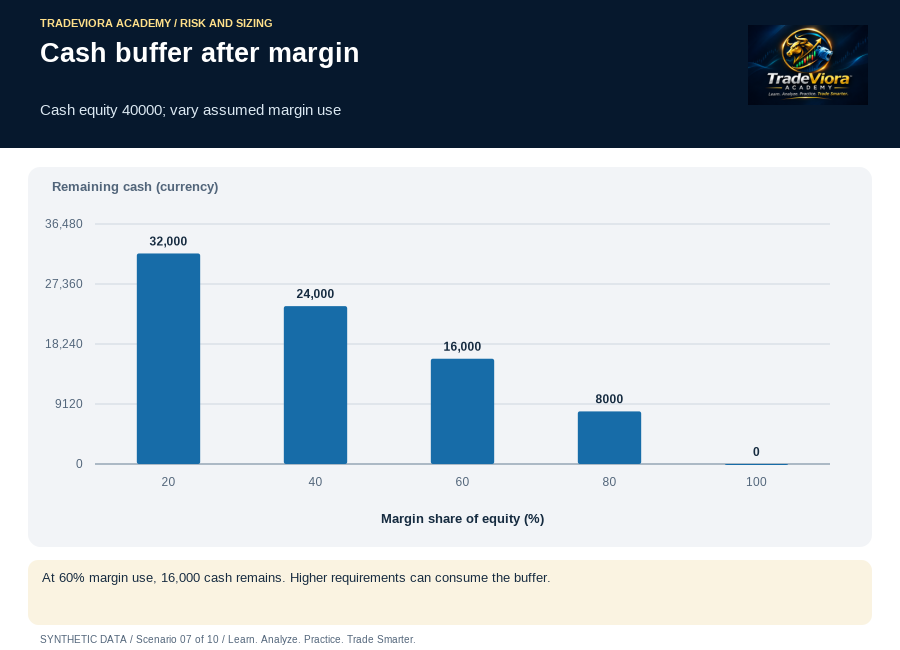
This separate synthetic case illustrates the arithmetic behind the topic. Its invented inputs are independent of the worked example above.
Download this concept’s cheat sheet · Explore scenario illustrations