
FREE FINANCIAL EDUCATION
Implied financing from a futures basis
Infer a financing rate under an explicit carry convention.
What you will learn
Prerequisites: Simple annual interest, spot/futures basis and expected distributions.
- Infer a financing rate under an explicit carry convention.
- Compare implied and attainable funding on matching terms.
- Explain why basis alone is not an annual return.
Mechanism and decision rules
An implied financing rate reverses a fair-value equation. Instead of inserting a rate to calculate a future, insert the observed future and solve for the rate that makes the modeled cash flows agree. Under a simple-interest teaching convention with dividends D credited at the horizon, F=S(1+rT)−D, so r=(F+D−S)/(S×T). Express T in the year fraction matching the rate convention.
The result is a model-implied number, not a borrowing offer. Comparing it with a bank quote requires consistent compounding, day count, collateral and credit terms. A three-month percentage basis cannot be compared directly with an annual funding rate. Expected income must also be included: the same observed futures premium can imply different financing when the cash asset pays a distribution.
When evaluating a possible carry trade, use prices attainable for the actual direction and size. For a cash purchase and futures sale, the cash ask and futures bid matter. Deduct execution, taxes where applicable, custody and financing of margin cash separately. If the implied rate is below the trader's available funding cost, a positive raw futures premium may still be insufficient to cover the trade.
Worked example · synthetic data
A fictional asset is 100, six-month futures are 102 and a cash distribution of 1 is assumed payable at the horizon. Using T=0.5 and simple annual interest, r=(102+1−100)/(100×0.5)=6%.
Suppose actual simple borrowing costs 8% for the same six months. Buying cash requires repayment of 104. Futures proceeds plus the distribution total 103. The modeled carry result is −1 per unit even before execution costs. Looking only at the positive two-point futures premium would miss both the distribution adjustment and the funding comparison.
Failure modes and limits
Dated dividends require timing adjustments when interest on those cash flows matters. A quoted future can be stale or reflect a different settlement reference from the cash price. Securities borrow constraints may make reverse comparisons asymmetric. Use an implied rate as a diagnostic input and document which omitted costs would change the economic result.
Practice case
Spot is 500, three-month futures are 508, and an expected distribution of 2 is credited at the horizon. With a quarter-year simple-interest convention, calculate the implied annual financing rate. What rate would be inferred incorrectly if the distribution were omitted?
Reveal the worked answer
Including income, r=(508+2−500)/(500×0.25)=8%. Omitting the distribution gives 8/125=6.4%. The discrepancy is 1.6 percentage points in annual rate terms. Neither number is an investment performance estimate; they are rates implied by two different cash-flow assumptions.
Check your understanding
Sources and next steps
The lesson, calculations and synthetic cases are original educational material. References explain underlying contract or chart conventions; none validates the profitability of a trading rule. Actual contract specifications, settlement obligations and charges must be checked before trading.
Explore OHLCV data in the chart lab · Explore volume-at-price and TPO data · Practice library
Related quantitative practice
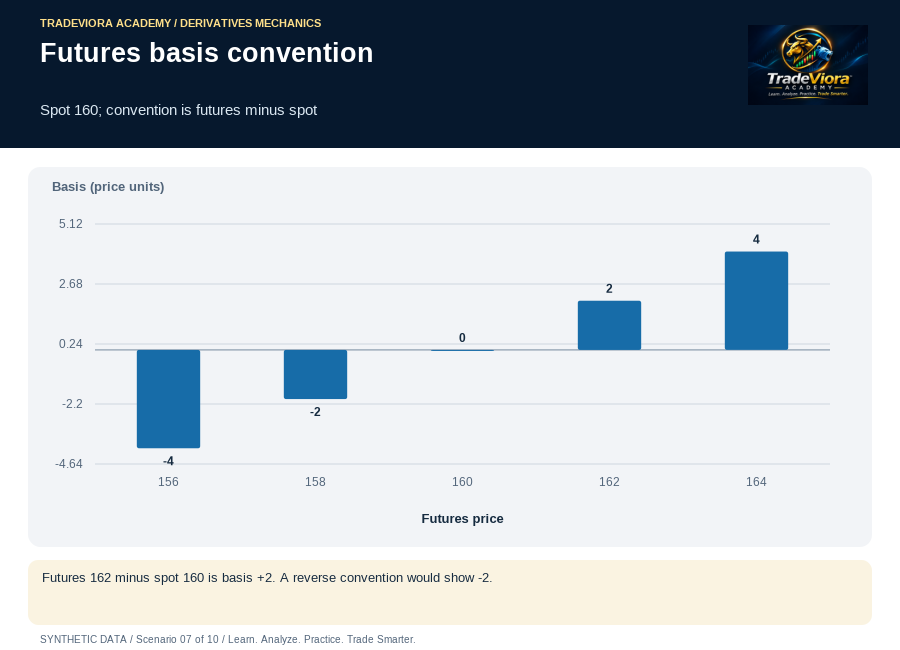
This separate synthetic case illustrates the arithmetic behind the topic. Its invented inputs are independent of the worked example above.
Download this concept’s cheat sheet · Explore scenario illustrations