APPLIED STUDY · ORIGINAL LESSON
Learning plan and prerequisites
Before you begin: Complete Measured moves and understand stop-distance position sizing.
- Recalculate geometry from the actual fill
- Include a consistent per-unit cost allowance
- Enforce risk and exposure limits after confirmation
Mechanism and interpretation
A chart pattern's boundary is a reference price, not an automatic execution price. A close-confirmed signal becomes available after the close, and the next eligible order can fill higher or lower. Entering farther from a structural stop increases risk per unit; entering nearer a fixed projected target reduces potential reward. The original drawing can remain unchanged while the proposed trade becomes materially different.
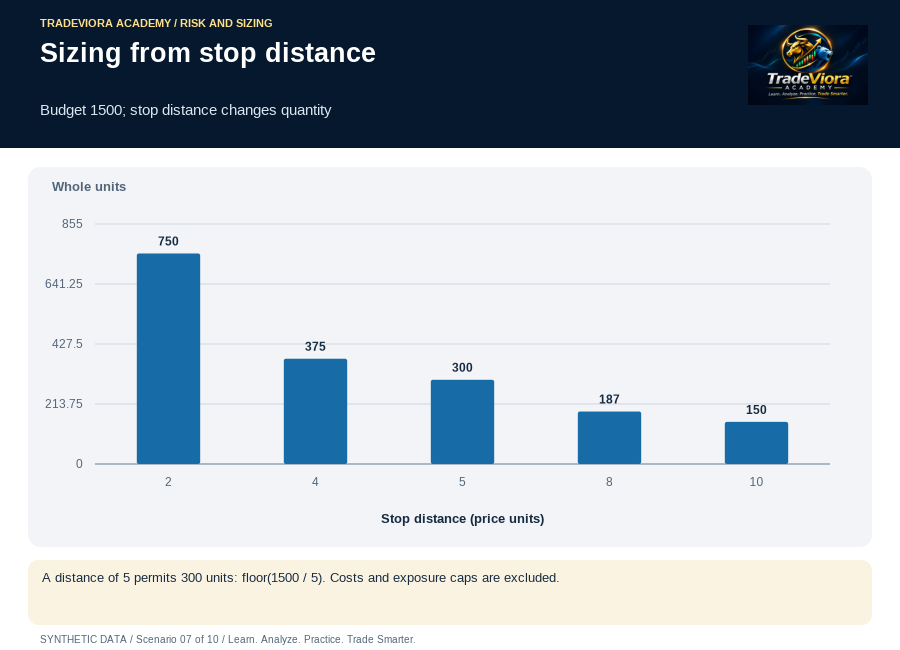
This lesson uses a fixed target, fixed stop and estimated round-trip cost per unit. For a long trade, net favorable result per unit is target minus actual entry minus cost; planned adverse result is actual entry minus stop plus cost. Dividing the first by the second gives a cost-adjusted ratio. Quantity is rounded down from currency risk budget divided by planned adverse result per unit, then checked against cash, notional, liquidity and valid-lot constraints. A stop is still not a guaranteed fill, so the budget is a planning estimate rather than a proven maximum loss.
Worked case — synthetic data
Synthetic target is 115, stop is 95, per-unit round-trip cost is 0.2 and risk budget is 500. Alternative actual fills are 101, 103 and 105. Their planned adverse results per unit are 6.2, 8.2 and 10.2; their net favorable results are 13.8, 11.8 and 9.8. Cost-adjusted ratios are approximately 2.226, 1.439 and 0.961. The corresponding risk-limited whole-unit quantities are 80, 60 and 49.
These are alternative fills for the same signal, not three positions to hold simultaneously. At fill 105, planned loss is 49 x 10.2 = 499.8. Reusing the 80-unit quantity calculated for fill 101 would instead plan 816 of loss, breaching the 500 budget. Confirmation can improve information while still worsening entry economics.
Context and failure modes
A minimum ratio or maximum entry distance can be a prospective skip rule, but it should be fixed before seeing which late entries later succeed. Moving the stop closer simply to preserve quantity changes the invalidation logic. Moving the target farther solely to restore a desired ratio changes the hypothesis. Neither adjustment should be presented as harmless arithmetic.
Practice task
A long entry fills at 202, stop is 196, target 214, estimated round-trip cost is 0.4 per unit and budget is 1,000. Compute planned adverse result per unit, whole-unit quantity, net favorable result per unit and the cost-adjusted ratio.
Worked practice answer
Adverse result is 202-196+0.4 = 6.4. Quantity is floor(1,000/6.4) = 156, with planned loss 998.4. Net favorable result per unit is 214-202-0.4 = 11.6. The ratio is 11.6/6.4 = 1.8125. Additional notional or lot constraints can reduce quantity further, and adverse execution can still exceed the planned amount.