FREE FINANCIAL EDUCATION
Event volatility compression in option packages
Reconcile a package’s post-event value rather than judging only underlying direction.
What you will learn
Prerequisites: Straddles, option marks and implied volatility.
- Reconcile a package’s post-event value rather than judging only underlying direction.
- Separate expiry breakevens from an earlier event-date exit.
- Explain why reduced uncertainty can offset favorable movement for long options.
Mechanism and decision rules
Before a scheduled event, option premiums can reflect uncertainty about the outcome. After the event, that uncertainty may decline, reducing residual option value even when the underlying moves. A long call can lose despite an upward stock move, and a long straddle can lose despite movement in either direction. The complete package mark, not the headline direction, determines the exit result.
Compare executable entry and exit quotes at the declared horizon. An expiry breakeven is not the exact threshold for a pre-expiry event trade because time value remains. Attribution to delta, vega and theta is approximate unless a full model reprices the inputs. Do not call every post-event loss IV crush without checking the actual quote and time changes.
Worked example · synthetic data
A synthetic strike 100 straddle is bought before an event for ₹7.50 call plus ₹7.50 put, total ₹15. After the event, spot is 106 and the still-unexpired options are marked at ₹8.50 call and ₹2.50 put, total ₹11. Closing at those assumed executable values loses ₹4 per unit despite a six-point underlying move.
The call–put difference is 6, consistent with the stated zero-rate, no-distribution parity simplification. The package’s lower total reflects less remaining optionality under these synthetic marks. A larger spot move or different IV response could produce another result.
Failure modes and limits
Marks may not be executable, especially around events. Bid–ask spreads can widen and quote timestamps can differ across legs. Event outcomes can change both expected volatility and underlying value. A two-point Greek approximation can be poor for large jumps or large IV changes.
Practice case
A pre-event package costs ₹24. At the planned post-event exit, its long call can be sold for ₹17 and long put for ₹4. Calculate P&L. Does an underlying move of ten points alone establish profitability?
Reveal the worked answer
Exit value is ₹21, so loss is ₹3 per unit before costs. The ten-point underlying move alone is insufficient; the premium paid and actual remaining option values determine the package’s result.
Check your understanding
Sources and next steps
The lesson, calculations and synthetic cases are original educational material. References explain underlying contract or chart conventions; none validates the profitability of a trading rule. Actual contract specifications, settlement obligations and charges must be checked before trading.
Explore OHLCV data in the chart lab · Explore volume-at-price and TPO data · Practice library
Related quantitative practice
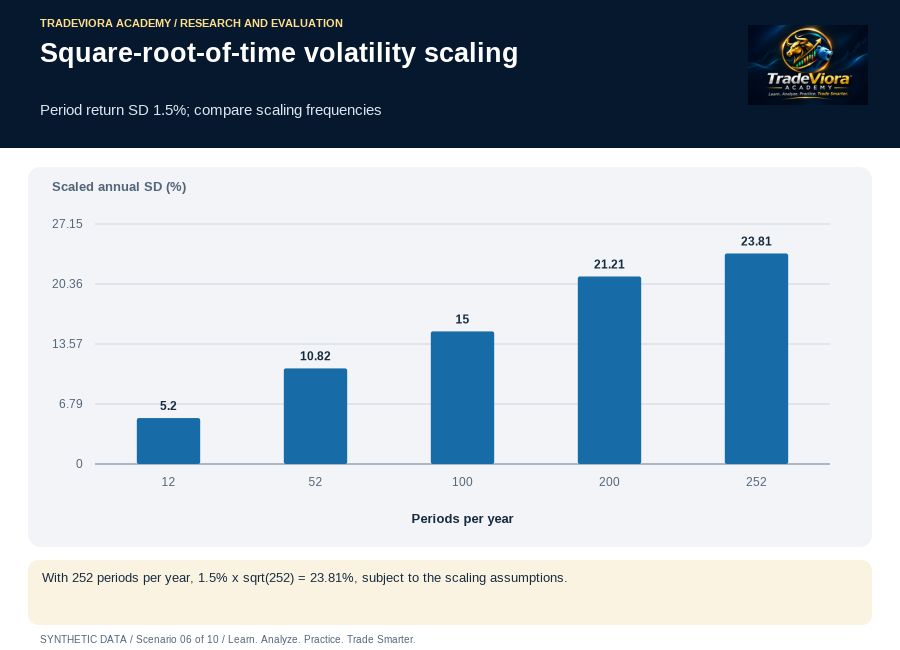
This separate synthetic case illustrates the arithmetic behind the topic. Its invented inputs are independent of the worked example above.
Download this concept’s cheat sheet · Run the related Python example · Explore scenario illustrations
Apply the measurement to genuine historical data
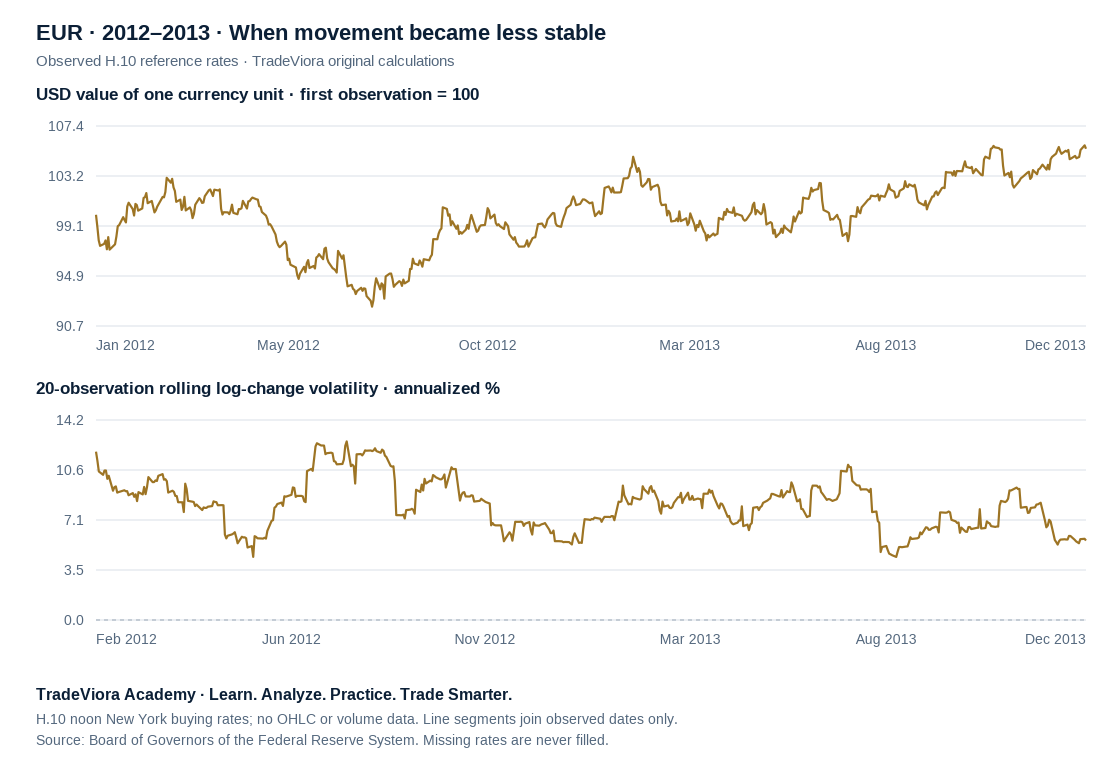
Euro, 2012–2013: when movement became less stable uses Federal Reserve H.10 reference-rate observations. It is an FX measurement exercise, not a test of a trading strategy or an OHLC candlestick record.