
FREE FINANCIAL EDUCATION
Delta hedging and rebalancing costs
Calculate an underlying hedge for a local option delta.
What you will learn
Prerequisites: Position delta, gamma and underlying trade quantities.
- Calculate an underlying hedge for a local option delta.
- Recompute the hedge after option delta changes.
- Separate local directional neutrality from total portfolio risk and transaction cost.
Mechanism and decision rules
A delta hedge adds underlying exposure opposite the option position’s current delta. If an option portfolio has +40 underlying-equivalent units, shorting 40 underlying units makes first-order net delta approximately zero at that instant. Gamma, time and volatility then change the option delta, so the hedge may need rebalancing under a specified schedule or threshold.
Rebalancing is not free. It crosses spreads, can move the market and may require borrow or funding. Continuous frictionless hedging is a model idealization, while actual systems trade discrete quantities at discrete times. A wider hedge band reduces turnover but permits more directional exposure. The tradeoff must be evaluated using realistic costs and jumps.
Worked example · synthetic data
A synthetic long option position represents 100 units with delta 0.40, so option delta is +40 and the initial hedge shorts 40 underlying units. After a price move, per-unit delta becomes 0.55, giving +55. The existing −40 hedge leaves net +15; selling 15 more units restores approximate zero delta.
If each additional hedge unit incurs ₹0.20 total immediate execution cost under the model, this rebalance costs ₹3. The hedge adjustment controls a local sensitivity but does not remove vega, theta, gamma or the possibility that price jumps before the next rebalance.
Failure modes and limits
Reported deltas are model estimates and can differ from realized price response. Shorting the underlying may be constrained. Cross-asset hedges require sensitivity conversion rather than raw unit matching. A delta-neutral position can lose from volatility changes, time decay and execution costs.
Practice case
An option portfolio’s delta changes from −60 to −45. It currently holds +60 underlying units as a hedge. What is net delta now, and what underlying trade restores approximate neutrality?
Reveal the worked answer
Net delta is −45+60=+15. Sell 15 underlying units, leaving +45 to offset the option delta −45. This calculation assumes the same underlying and unit convention and ignores changes during execution.
Check your understanding
Sources and next steps
The lesson, calculations and synthetic cases are original educational material. References explain underlying contract or chart conventions; none validates the profitability of a trading rule. Actual contract specifications, settlement obligations and charges must be checked before trading.
Explore OHLCV data in the chart lab · Explore volume-at-price and TPO data · Practice library
Related quantitative practice
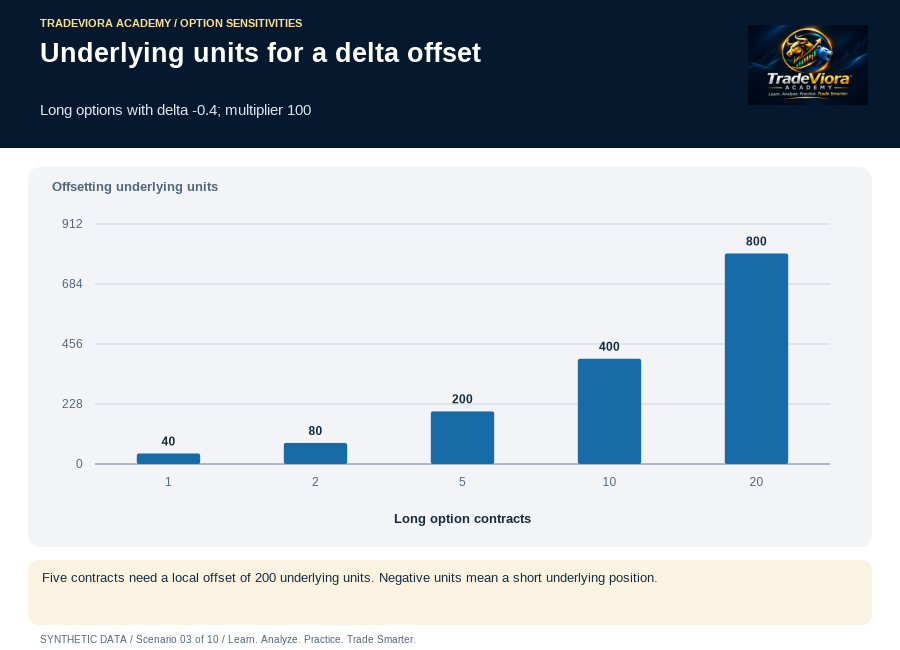
This separate synthetic case illustrates the arithmetic behind the topic. Its invented inputs are independent of the worked example above.
Download this concept’s cheat sheet · Explore scenario illustrations