Learning objectives
- Normalize bar activity against matched time-of-day observations.
- Interpret volume jointly with range and close location.
Prerequisites: Read OHLCV, calculate a median and distinguish bar range from bid–ask spread.
Mechanism and interpretation
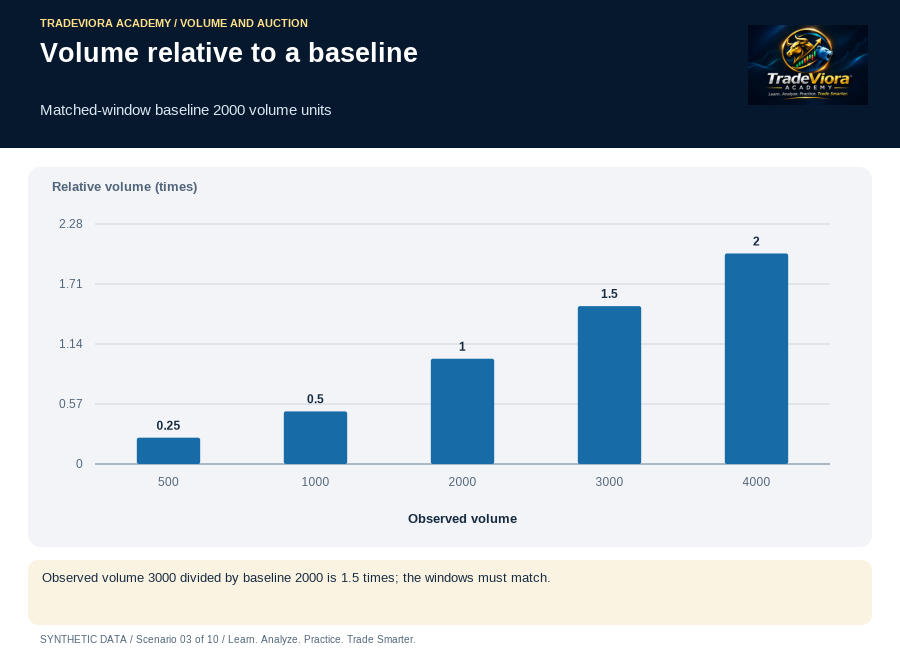
In this lesson bar spread means high minus low, not the bid–ask spread. Relative volume is current completed-bar volume divided by a baseline for the same clock-time slot over earlier comparable sessions. An opening bar should not be judged against a typical quiet midday bar. A median baseline limits the influence of a few extraordinary sessions but does not remove all event effects.
Close location can be defined as (C−L)/(H−L), between zero and one when the range is positive. Combine this with normalized range and relative volume to describe activity. Wide range and a close near the high differ from narrow range on the same volume. The descriptors organize observations; they do not identify buying or selling pressure without additional data and testing.
Worked case · synthetic data
A completed 10:00 bar has volume 2,000 against a matched-slot historical median of 1,000, giving relative volume 2. Its H=105, L=101, C=104, so range=4 and close location=3/4=0.75. Another bar with the same volume, H=103, L=102, C=102.5 has range=1 and close location=0.5. Calling both simply high-volume hides the difference in price movement.
Failure modes and context
Partial bars should be compared with elapsed-time-matched baselines, not completed-bar totals. Shortened sessions, holidays, contract rolls and corporate events change comparability. A zero range makes the close-location ratio undefined; assign an explicit missing state. Price can rise on both high and low relative volume, so the ratio alone supplies no direction.
Practice assignment
Earlier comparable-slot volumes are 800,900,1,000,1,100,3,000. Today's completed volume is 1,500 with H=202, L=198, C=199. Compute median-relative volume and close location. Explain how using the mean baseline changes the volume ratio and why neither choice should be selected after seeing returns.
Worked answer
Median=1,000, so relative volume=1.5. Close location=(199−198)/4=0.25. The mean baseline is 1,360, producing about 1.103 rather than 1.5. The unusually large 3,000 observation raises the mean. Baseline choice changes labels and belongs in the measurement specification before testing.
Check your understanding
Question 1
What does spread mean in this lesson?
- Ask minus bid
- Average traded price
- High minus low
Reveal answer and reasoning
C. High minus low
The terminology is explicitly bar range; it must not be confused with quote spread.
Question 2
Why match the clock-time slot?
- It identifies trade aggressors
- Intraday activity is seasonal
- Every slot has identical activity
Reveal answer and reasoning
B. Intraday activity is seasonal
Opening and midday volume often differ even without unusual events.
Question 3
What is close location for H=202, L=198, C=199?
- 0.25
- 0.75
- 1.5
Reveal answer and reasoning
A. 0.25
The close is one point above the low within a four-point range.