
FREE FINANCIAL EDUCATION
Initial balance and range extension
Define initial balance with a fixed opening duration.
What you will learn
Prerequisites: Session timestamps, high–low ranges and TPO block definitions.
- Define initial balance with a fixed opening duration.
- Measure extensions above and below the completed initial balance.
- Distinguish a descriptive range extension from a directional forecast.
Mechanism and decision rules
Initial balance is the high–low range of a predeclared opening interval, often the first two TPO blocks in a given convention. It is a time-defined reference, not an automatically universal one-hour rule. A different market session or block size can imply another duration. The initial balance becomes final only after the designated interval ends.
Range extension occurs when later trading reaches beyond the completed initial-balance high or low. Measure upper and lower extensions separately. Dividing extension distance by initial-balance width creates a comparable descriptive scale, but a narrow initial balance can make a modest move look large on that ratio. A break may continue, reverse or establish a new distribution; the extension label alone chooses none of these outcomes.
Worked example · synthetic data
In a synthetic session, the first two 30-minute blocks create an initial balance from 200 to 210, width 10. Later trading reaches 216 and 198. Upper extension is 216 − 210 = 6, or 0.6 initial-balance widths. Lower extension is 200 − 198 = 2, or 0.2 widths. The full observed session range is 198–216, width 18.
At the end of only the first block, the eventual 200–210 range was not yet fixed. A rule using that final balance during the first block would look ahead.
Failure modes and limits
The opening auction and overnight session may be included or excluded depending on settings. A zero or tiny initial-balance width makes normalized ratios unstable. Day-type labels based on final range should not be fed back into morning entries. Holidays and shortened sessions need explicit treatment.
Practice case
Initial balance is 500–512. Later high is 530 and low is 498. Compute its width, upper and lower extension distances, and each extension as a multiple of the initial-balance width.
Reveal the worked answer
Width is 12. Upper extension is 18, or 1.5 widths. Lower extension is 2, or about 0.167 widths. Both sides extended, but these distances alone do not identify the sequence or closing location; those require additional observations.
Check your understanding
Sources and next steps
The lesson, calculations and synthetic cases are original educational material. References explain underlying contract or chart conventions; none validates the profitability of a trading rule. Actual contract specifications, settlement obligations and charges must be checked before trading.
Explore OHLCV data in the chart lab · Explore volume-at-price and TPO data · Practice library
Related quantitative practice
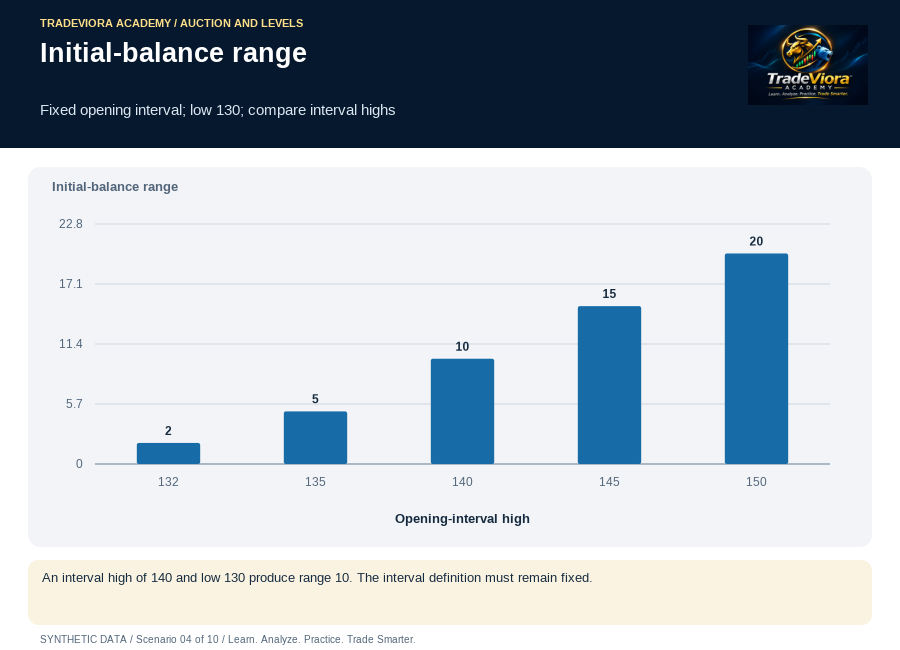
This separate synthetic case illustrates the arithmetic behind the topic. Its invented inputs are independent of the worked example above.
Download this concept’s cheat sheet · Explore scenario illustrations