Learning objectives
- Calculate a frozen floor-pivot map from a completed session.
- Separate arithmetic reference levels from evidence about resting orders.
Prerequisites: Read OHLC bars and distinguish the completed session from the current session.
Mechanism and interpretation
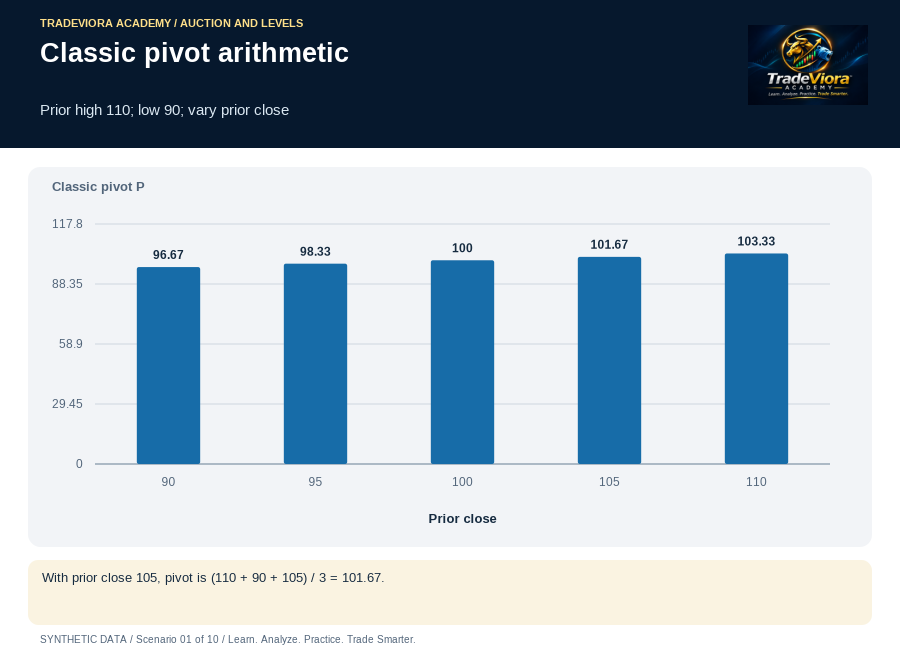
A floor-pivot map is a transformation of three observations, not a measurement of orders. In this lesson P=(H+L+C)/3, R1=2P−L, S1=2P−H, R2=P+(H−L), and S2=P−(H−L). Specify the instrument, session boundary and definition of close before calculating. A last trade and a futures settlement are different possible inputs. Freeze the resulting map until the next chosen period completes.
The geometry helps catch errors. R2 and S2 are equally distant from P by the prior range. R1 and S1 need not be equally distant from P because the close affects P. Moving every input up by ten moves every level up by ten without changing spacing. None of these identities supplies a probability of reversal. A trading hypothesis needs an observable event at a level, a decision time and an executable order rule.
Worked case · synthetic data
Synthetic session H=110, L=90, C=106 gives P=102. R1=204−90=114; S1=204−110=94. R2=122 and S2=82. Prior high 110 remains a separate reference: it is not the same as R1. If the next session opens at 116, the map stays unchanged. Replacing H with that session's developing high would create a different, moving indicator.
Failure modes and context
Mixing an overnight high with a regular-session close can make two otherwise correct calculators disagree. Corporate-action adjustments and contract changes also matter. Rounding each intermediate calculation can shift the final level; keep precision until converting an order price to an allowed tick. A chart touching R1 does not prove liquidity existed there or that a trade filled.
Practice assignment
Use H=208, L=192, C=200. Calculate P, R1, S1, R2 and S2. Then explain whether a next-day high of 215 should change this particular map. State one piece of information needed before comparing your values with a platform.
Worked answer
P=200; R1=208; S1=192; R2=216; S2=184. The next-day high does not enter a map defined from the completed prior session. Check the platform's session definition or close convention before blaming arithmetic. Here the close equals the range midpoint, which makes the first pair symmetric.
Check your understanding
Question 1
With P=102 and prior low=90, what is R1?
- 114
- 112
- 122
Reveal answer and reasoning
A. 114
R1=2×10²−90=114; 122 is R2 in the worked case.
Question 2
Which observation can construct the stated next-session map?
- The next session final high
- Tomorrow’s final settlement
- The completed prior-session high
Reveal answer and reasoning
C. The completed prior-session high
The rule freezes information available after the prior session has completed.
Question 3
What does an R1 price label establish?
- A measured fill probability
- An arithmetic reference
- A guaranteed supply wall
Reveal answer and reasoning
B. An arithmetic reference
The formula uses OHLC; it contains no resting-order or execution information.